
Resource Center / Articles / Sanity Pricing in 2027: Plans, Overages and Monthly Bills
Sanity Pricing in 2027: Plans, Overages and Monthly Bills
 Uros Stancic • Sanity • Published on Oct 20, 2026 • Updated on Oct 20, 2026 • 10 min read

TL;DR
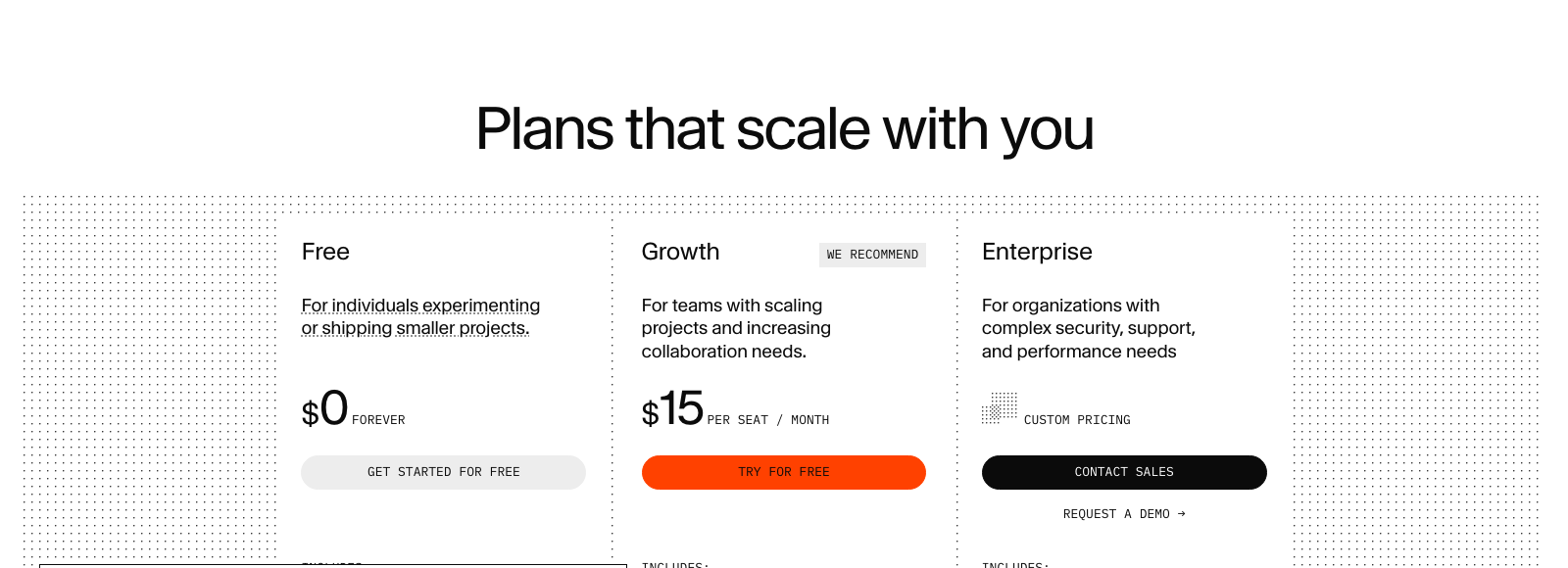
Sanity's cheapest paid plan cost $99 a month until November 2023, and some review sites still quote it. Sanity pricing today has three plans: Free at $0, Growth at $15 per seat a month, and Enterprise at a quoted price.
- Free covers 20 seats, 10,000 documents, and 1M CDN requests a month, with hard caps. khod.io runs 180+ pages on it.
- Growth is $15 per seat for anyone except Viewers, plus pay-as-you-go usage. A team of five editors and a developer pays $90 a month.
- Enterprise adds SSO, custom roles, Content Releases and an SLA, billed annually on invoice.
- The lines that surprise people: a third dataset at $999 a month, a 25,000-document cap that only a $299 bundle lifts, and a 30-day trial that turns non-admin users into Viewers when it ends.
- For a site that caches its pages, the bill is mostly seats. Ours uses 13% of the CDN quota and 9% of the uncached one.
Search for Sanity's price and you'll find $0, $15, $99, $949 and $1,399, sometimes on the same page. All five were Sanity prices at some point. Sanity has replaced its whole plan lineup twice since 2021 and changed what the plans include many more times, and the review sites that rank for it are quoting different years.
This guide prices Sanity as it stands today, with every figure checked against Sanity's pricing page on October 21, 2026, and shows the maths: what you pay beyond seats, four worked monthly bills, our own usage on khod.io, and how the plans got here. If you're still deciding whether Sanity fits at all, start with what Sanity CMS is and how it works.
Sanity CMS pricing in 2027: the three plans
Sanity sells three plans. Growth is billed monthly to a card with no minimum term; Enterprise is billed annually on invoice.
Free: $0, with hard caps
Free costs $0 with no time limit and runs production sites, ours included. Two limits shape it.
Every user is an Administrator or a Viewer. Free has no Editor role, so anyone who edits content can also invite people, create API tokens and delete datasets. For a founder and two trusted marketers that's fine. For a team with freelancers it's a risk.
The limits are hard caps. Free has no pay-as-you-go. When a project passes its monthly requests or bandwidth, Sanity blocks the API with an HTTP 402 error until the counters reset at midnight UTC on the first of the month, so builds, previews and any page that queries Sanity live fail. Sanity emails a warning at 80% and again at 100%. At 10,000 documents nobody can create a document or start a new draft, and drafts count: a document with unpublished changes counts twice.
Growth: $15 per seat, plus usage
Growth costs $15 per seat a month for up to 50 seats. Every user takes a seat except Viewers, who are free on every plan, and API tokens don't take seats. Developers who log into the Studio do.
Growth adds the Editor, Contributor and Developer roles, comments, tasks, scheduled drafts, AI Assist, private datasets and 90 days of history. Past the included quotas it bills pay-as-you-go where Free blocks, with one exception: documents stop at 25,000 unless you buy the $299 Increased quota bundle.
Enterprise: quoted, from a sales call
Enterprise has no list price. It adds SSO, custom roles, Content Releases for publishing many documents together, the full audit trail, dataset backups and cloning, a custom CDN domain and an uptime SLA, with 365 days of history and 5,000 AI credits a month.
What you pay for beyond seats
Seats are the predictable part of a Growth bill. These are the other lines, all monthly:
Pay-as-you-go costs less than the $299 bundle unless you need its documents or a lot of extra assets. Using every extra request and gigabyte the bundle includes would cost $366 on pay-as-you-go: $16 of CDN requests, $30 of API requests, $120 of bandwidth and $200 of asset storage. A site that stays under 100 GB of assets and within the bundle's traffic levels pays well under $299. Buy the bundle when you need more than 25,000 documents, because documents have no pay-as-you-go rate.
A third dataset costs more than a full Growth team. At $999 a month, an extra dataset costs more than all 50 Growth seats ($750). Two datasets cover production plus one shared by development and staging.
Languages run into a different limit. Plans include unlimited locales, but every dataset has a cap on unique attributes, each distinct field path in your content: 2,000 on Free and 10,000 on Growth. When every field stores every language, each new language adds paths, so a large page builder in six languages reaches that cap long before any request limit.
AI credits went up tenfold in May 2026. Free and Growth now include 1,000 credits a month and Enterprise 5,000. Extra credits are $0.05 each on Growth.
Sanity pricing calculator: estimate your bill
The calculator below applies the prices above to your numbers. Enter where you expect the project to be in a year; it picks the plan and itemises the monthly bill.
Sanity pricing calculator
Change any number and the plan and monthly bill update. List prices, checked 2026-10-21; excludes the cost of building the site.
Free: $0 a month
| Free plan | $0 |
| Total a month | $0 |
Why Free: everything fits inside the Free limits.
Free blocks the API at its caps rather than billing, so watch the 80% warning email.
Four monthly bills, worked out
A founder-led marketing site: $0. Three people edit, all trusted with project settings, across about 1,500 documents. The site is built ahead of time and cached, so it reads from Sanity's CDN and stays inside Free's request limits.
Five marketers and a developer: $90 a month. The marketers need the Editor role so they can't touch settings, and the team wants scheduled publishing for launches. That's Growth at six seats. Two sales leads who only read drafts join as Viewers for free.
A 12-person content team with 40,000 documents: $479 a month. Twelve seats come to $180. Forty thousand documents is past Growth's cap, so the team adds the $299 bundle, which also raises traffic to 5M CDN requests and 500 GB of bandwidth, so overages stay at zero while traffic stays within those.
The same team with development, staging and production kept apart: $1,478 a month. Growth includes two datasets, so the third costs $999 on its own, twice everything else on the bill. Sharing one dataset between development and staging brings the bill back to $479.
What we pay to run khod.io on Sanity
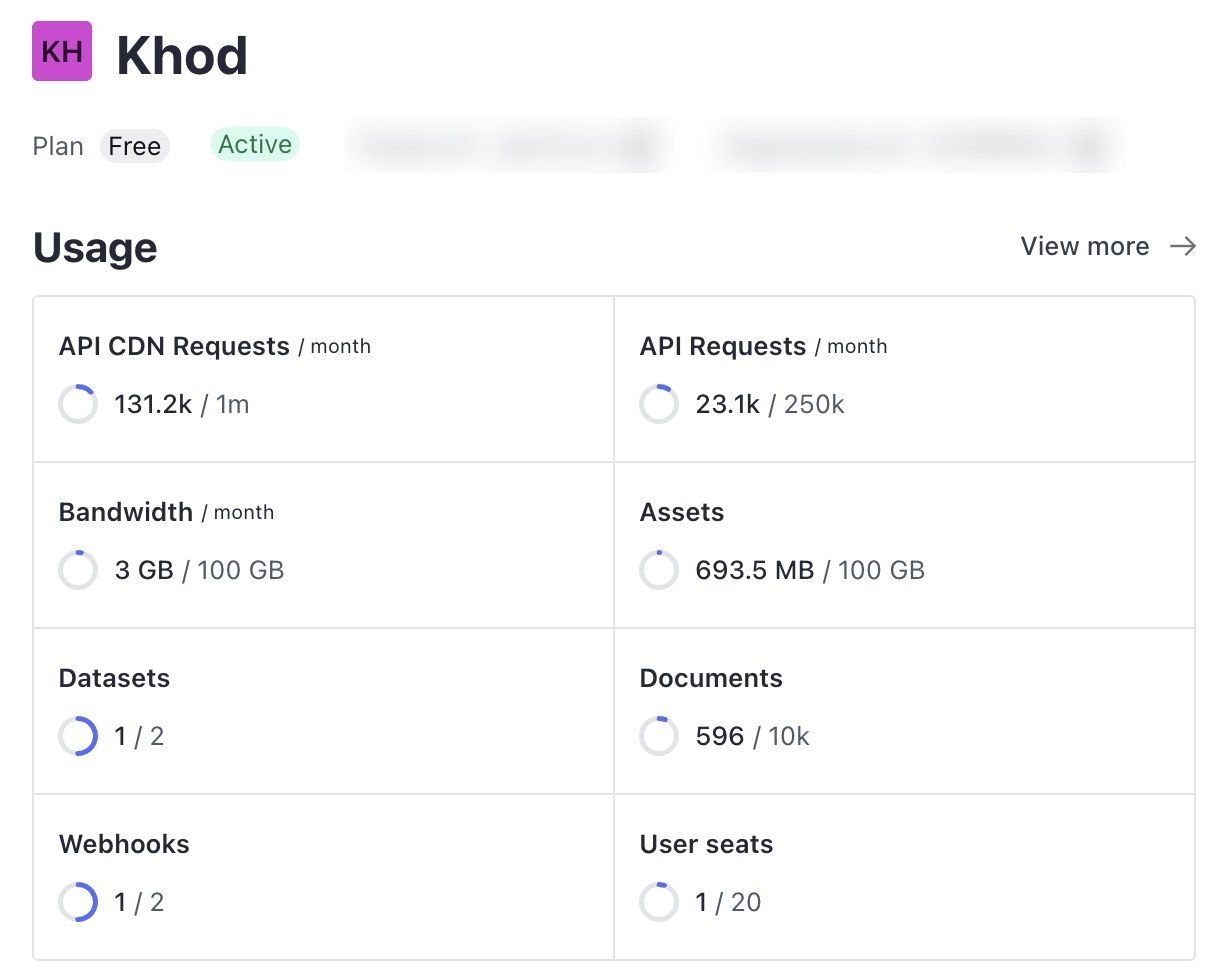
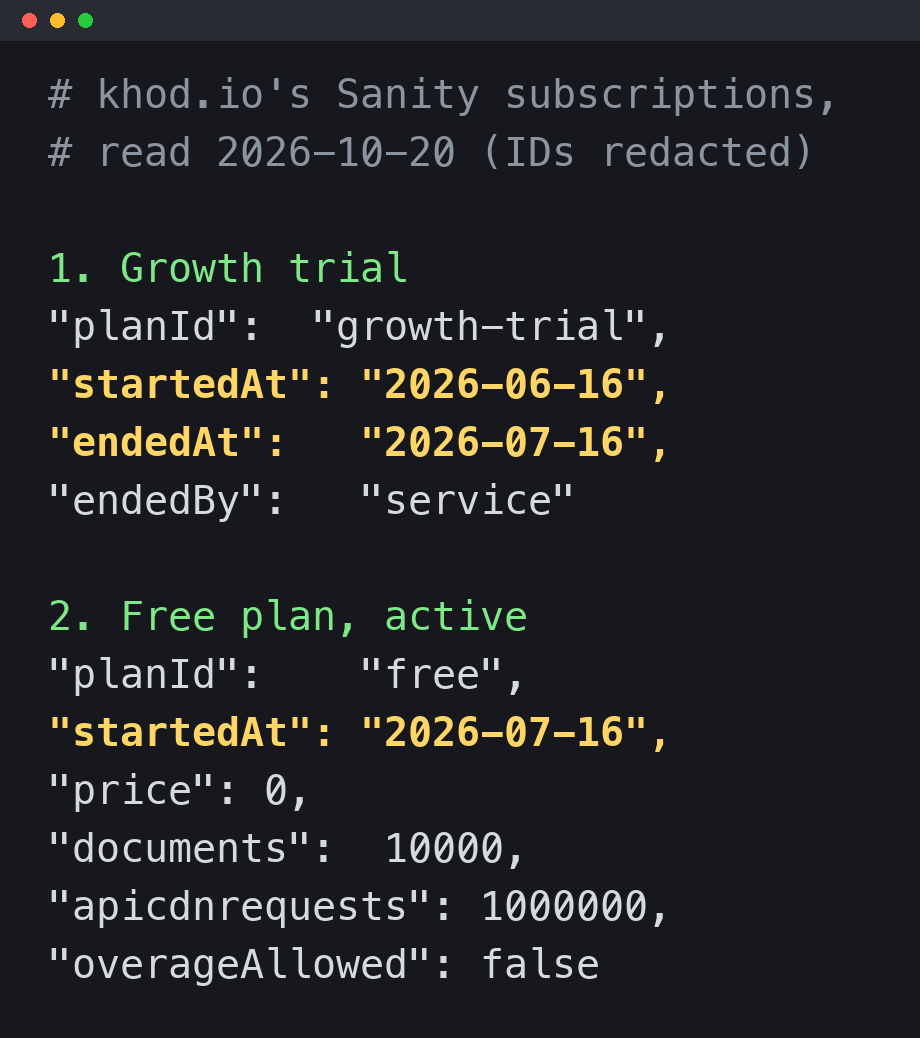
$0 a month, since July 16, 2026. We rebuilt khod.io on Next.js and Sanity between June 16 and July 4. Creating the project started a 30-day Growth trial on its own; we never entered a card. Sanity's records show the trial ended on July 16 and moved us to Free, where we've stayed. Our numbers on October 21, 2026, from Sanity's dashboard:
- 131,200 of 1M CDN requests and 23,100 of 250,000 uncached API requests, three weeks into the month. Our pages are prerendered and cached for up to 24 hours, so visitors read cached pages and the site reads from Sanity when a page rebuilds.
- 3 GB of 100 GB bandwidth and 693.5 MB of 100 GB assets for 1,423 images and 12 files.
- 596 of 10,000 documents. 222 are reports our website teardown tool saves, about 65 a month, so tools count toward the cap along with editors.
- One human seat of 20. Our agents edit through API tokens, which don't take seats.
Three things would move us to Growth: a second person who edits content but shouldn't touch settings, scheduled publishing for launches, or a private dataset.
How Sanity's pricing changed since 2021
We read 70 archived copies of Sanity's pricing page from 2021 to 2026. Each date is the first archived copy that shows the change:
Sanity announced today's three plans on November 16, 2023, replacing four. The old Team plan started at $99 per project a month with 10 non-admin users, and Business at $949 with 20; the August 2023 snapshot shows both. Our own project's plan IDs end in 2023-10-19, the internal date of the plans Sanity launched four weeks later.
Growth has cost $15 per seat since launch, and the $299, $799 and $999 add-ons have kept their prices. The movement has been in what each plan includes: SSO and Content Releases left Growth, and AI credits arrived and grew.
What the pricing page doesn't spell out
The trial ends on its own, and takes roles with it. When a Growth trial ends without an upgrade, private datasets become public and non-admin users become Viewers. If you invited editors as Editors during the trial, they lose edit access on day 31. Before then, add a card and move to Growth, or make the people who edit Administrators.
Uncached requests use the expensive quota. Requests through Sanity's CDN cost $1 per 250,000 over the limit; uncached API requests cost $1 per 25,000, ten times as much per request, from a quota four times smaller. Live preview, draft mode and server code that skips the CDN all draw from the uncached pool.
Drafts and releases count as documents. A document with unpublished changes counts twice, and on Enterprise each version in a content release counts once more. Images and files use the asset quota instead.
You can't pay yearly on Growth. Self-serve plans are monthly only; annual billing and invoices come with Enterprise.
How to keep a Sanity bill down
These are the choices that keep khod.io at $0 and that we'd make on a Growth project too:
- Cache your pages. A prerendered, cached site reads from the CDN on rebuilds, which is how ours stays at a small fraction of Free's request limits.
- Give scripts and agents tokens. API tokens don't take seats.
- Make reviewers Viewers. Anyone who only reads drafts or leaves feedback outside the Studio can be a free Viewer.
- Share a dataset between development and staging. It saves $999 a month against a third dataset.
- Watch tools that write documents. A form or tool that saves a document per visitor fills a 10,000 or 25,000 cap faster than any editor.
- Check the discount programs first. The Startup Program gives a year of Growth free to startups with fewer than 20 employees and under $5M raised, through Sanity's partners. The non-profit plan mirrors Growth for free within its quotas, with 25 users and three datasets.
Sanity vs Contentful, Storyblok, Prismic and Strapi on price
The table prices the cheapest paid plan for 5, 10 and 20 editors at monthly list prices from each vendor's pricing page on October 21, 2026.
On paid plans, Prismic costs least at five editors, at $30. At ten, Sanity and Strapi's Growth plan tie at $150, against $174 on Storyblok, $180 on Prismic and $300 on Contentful. At twenty, Prismic's $180 Medium tier is cheapest, Sanity, Contentful and Strapi's Growth plan meet at $300, and Storyblok needs a sales call. Free tiers change the picture for small teams: Contentful's covers 10 users and Strapi's Community edition has no user limit, if you host it yourself.
Price is one column of the decision. Our guide to Next.js CMS options compares how each one handles previews, page building and approvals. The same comparison for Astro sites is in Astro CMS options.
The full cost of a Sanity website
The Sanity bill is one of three lines, and the one-off build is the largest.
- The CMS: $0 on Free, $15 per seat a month on Growth.
- Hosting for the site. Sanity hosts the content and the Studio. The website runs on a host like Vercel, whose Hobby tier is for personal, non-commercial use, so a company site belongs on Pro, at $20 a month per developer.
- The build. Someone defines the content model, builds the page sections and wires up preview, once. At Khod a Webflow to Sanity migration starts from $5,000. Our website migration cost guide prices the other platform moves. If you're still choosing a platform, our Webflow vs Sanity comparison covers editing, content limits and lock-in.
Put together, a team of five marketers and a developer pays about $110 a month to run the site, $90 to Sanity and $20 to Vercel, after the one-off build.
Frequently asked questions
Is Sanity free?
Yes. Sanity's Free plan costs $0 with no time limit and covers 20 seats, 10,000 documents, two public datasets, 1M CDN requests and 250k API requests a month. Its limits are hard caps, and every user is an Administrator or a Viewer.
How much does Sanity cost per user?
$15 per seat per month on Growth, for up to 50 seats. Viewers are free on every plan and API tokens don't take seats. Enterprise pricing is quoted per customer.
Why do some sites say Sanity costs $99 a month?
They're quoting the Team plan Sanity retired in November 2023, which started at $99 per project a month. The Business plan at $949 and the $1,399 SSO add-on are also gone; SSO is Enterprise-only since June 2026.
Is there a Sanity pricing calculator?
Sanity's pricing page doesn't have one. The calculator in this article takes your seats, documents, datasets, monthly usage and the features you need, then names the plan and itemizes the monthly bill line by line.
What happens when the Sanity trial ends?
Every new project gets 30 days of Growth features. When the trial ends without an upgrade, the project moves to Free, private datasets become public and users other than Administrators become Viewers. Your content stays.
Does Sanity charge overages on the Free plan?
No. Free has hard caps: past a monthly limit Sanity blocks the API with an HTTP 402 error until the month resets. Pay-as-you-go overages start on Growth.
Can you pay for Sanity annually?
Only on Enterprise. Free and Growth are billed monthly, by card, with no minimum term.
Is Sanity cheaper than Contentful?
On paid plans, yes up to 19 editors, and the two are equal at 20: Sanity Growth costs $15 per seat, so 10 editors pay $150 a month against Contentful Lite's flat $300 for up to 20 users. Contentful's free tier covers 10 users with hard caps.
Share the Article


Want us to set up Sanity?
We build marketing sites on Next.js and Astro with Sanity behind them, and we run our own site on it. Tell us who edits your site and we'll size the plan before we build.
See Khod First on Google
Uros is the brains behind the builds, turning Figma files into clean, scalable sites. He builds Webflow sites so smooth, you’ll think they coded themselves.
Outside the Webflow canvas, you’ll find him testing out new recipes, planning his next weekend escape, or deep in thought wondering why websites break at 3AM and not during office hours.
Table of Content
Want us to set up Sanity?
We build marketing sites on Next.js and Astro with Sanity behind them, and we run our own site on it. Tell us who edits your site and we'll size the plan before we build.
See Khod First on Google
Explore Related Articles

Website Strategy • Nov 2, 2026 • 11 min read
Website Replatforming: What It Is and When a B2B Team Should Do It
Sanity • Oct 27, 2026 • 13 min read
Webflow vs Sanity: Which One Fits Your Team?
Sanity • Oct 20, 2026 • 11 min read
What Is Sanity CMS? How It Works and What It Costs in 2027Your Next Deal Starts With Your Website
Most deals are won or lost before your sales team gets involved. Let's make sure your site is ready for that moment.
