
Resource Center / Articles / Sanity vs Contentful: Prices, Limits and Which One Fits in 2026
Sanity vs Contentful: Prices, Limits and Which One Fits in 2026
 Evgenii Tilipman • Sanity • Published on Nov 20, 2026 • Updated on Nov 20, 2026 • 11 min read

TL;DR
Pick Sanity if your site is built in code, whether a developer or, more and more often, an AI coding agent writes it. The schema lives in your repo, so an agent can add a section type, its fields and the page that shows it in one change. It's free for up to 20 seats and has no limit on content types.
Pick Contentful if you need enterprise governance, want admins to change the content model without a deploy, or already work inside Salesforce.
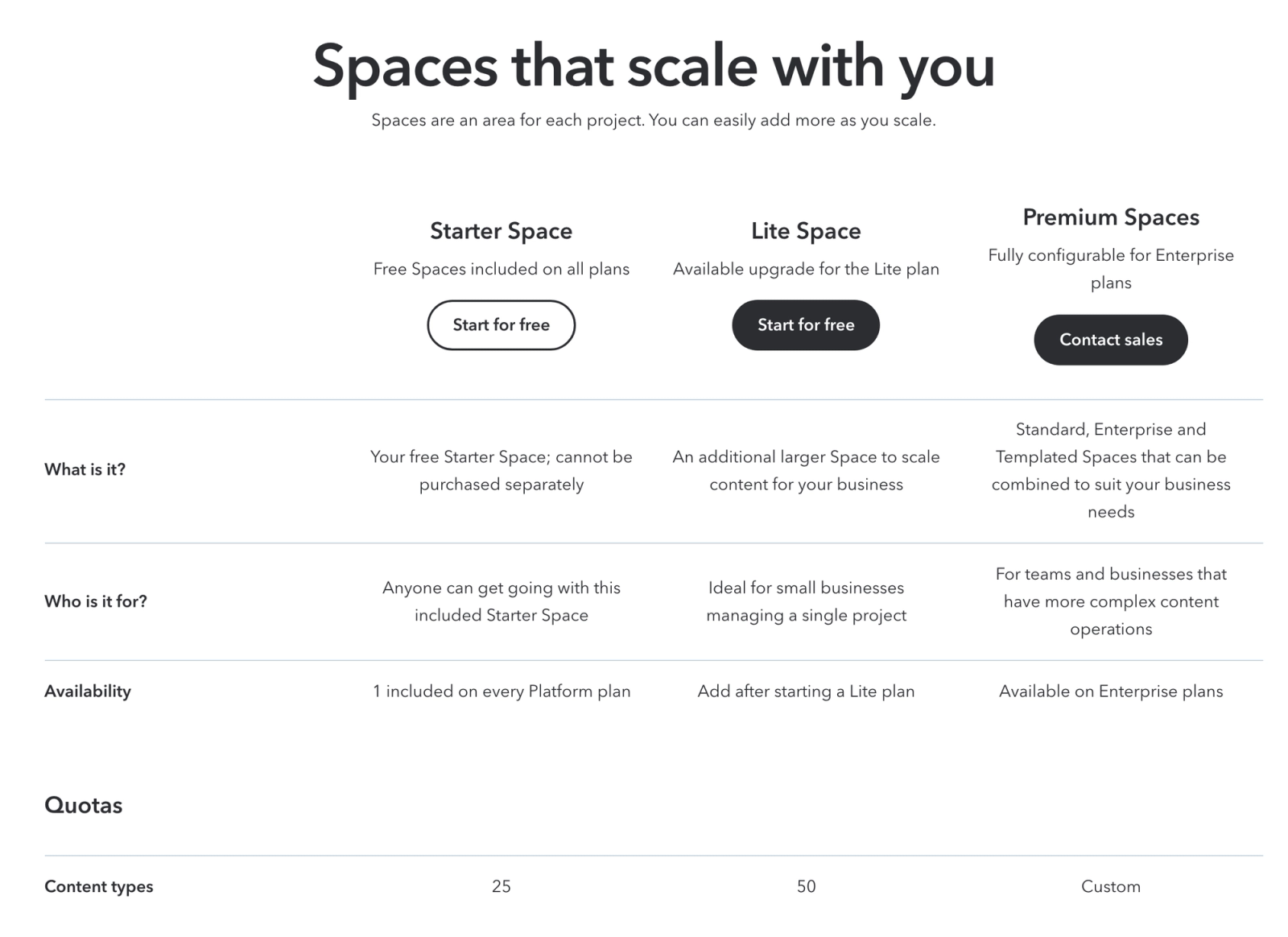
- Content types decided it for our site. Contentful caps them per space: 25 on Free and Lite, 50 on a Lite Space that costs another $850 a month. Our own site uses 62, so it would need Contentful Enterprise. On Sanity it costs us $0.
- Sanity costs less until about 20 people. Contentful is free for up to 10 users, Lite is $300 a month for up to 20, and Enterprise is quoted. Sanity is free for up to 20 seats, then $15 per seat a month on Growth. At 20 editors and a developer the two cost about the same: $315 against $300.
- Contentful is now part of Salesforce. Salesforce completed the acquisition on September 1, 2026.
We moved our own site to Sanity in June 2026 and have managed its content there since. Today one Sanity project holds:
- 30 pages and 81 articles
- 7 migration pages
- 226 reports saved by our website teardown tool
We don't build on Contentful, so every Contentful figure here comes from its pricing page and developer docs, which we read on November 20, 2026. Where a Contentful quota matters, we checked it against our own content model and usage.
If Sanity itself is new to you, start with what Sanity CMS is.
Sanity vs Contentful at a glance
The table follows from one difference in how the two sell:
- Sanity charges per seat and meters usage. Going over a usage quota adds a few dollars to the bill.
- Contentful sells plans with fixed quotas. Outgrowing its user, locale or content-type quota moves you up a plan.
What Sanity and Contentful cost at 5, 10 and 20 editors
Both have a free plan you can launch a site on. They split at the first paid step: Sanity charges per person, Contentful per plan.
Here is the same team on each, with one developer added, on monthly billing:
What the free plans allow
Sanity's Free plan has two roles, Administrator and Viewer. So the $0 line only works if everyone who edits can also change project settings.
Adding an editor who shouldn't touch settings means moving to Growth.
Contentful's Free plan has an Editor role, but it caps you at 25 content types and 100,000 API calls a month, with no option to pay for more.
Where the prices meet
At 20 editors and a developer the two cost about the same: $315 against $300.
Past that, Contentful needs an Enterprise quote and Sanity keeps adding $15 a seat up to 50. Our Sanity pricing guide has every overage rate and four worked monthly bills.
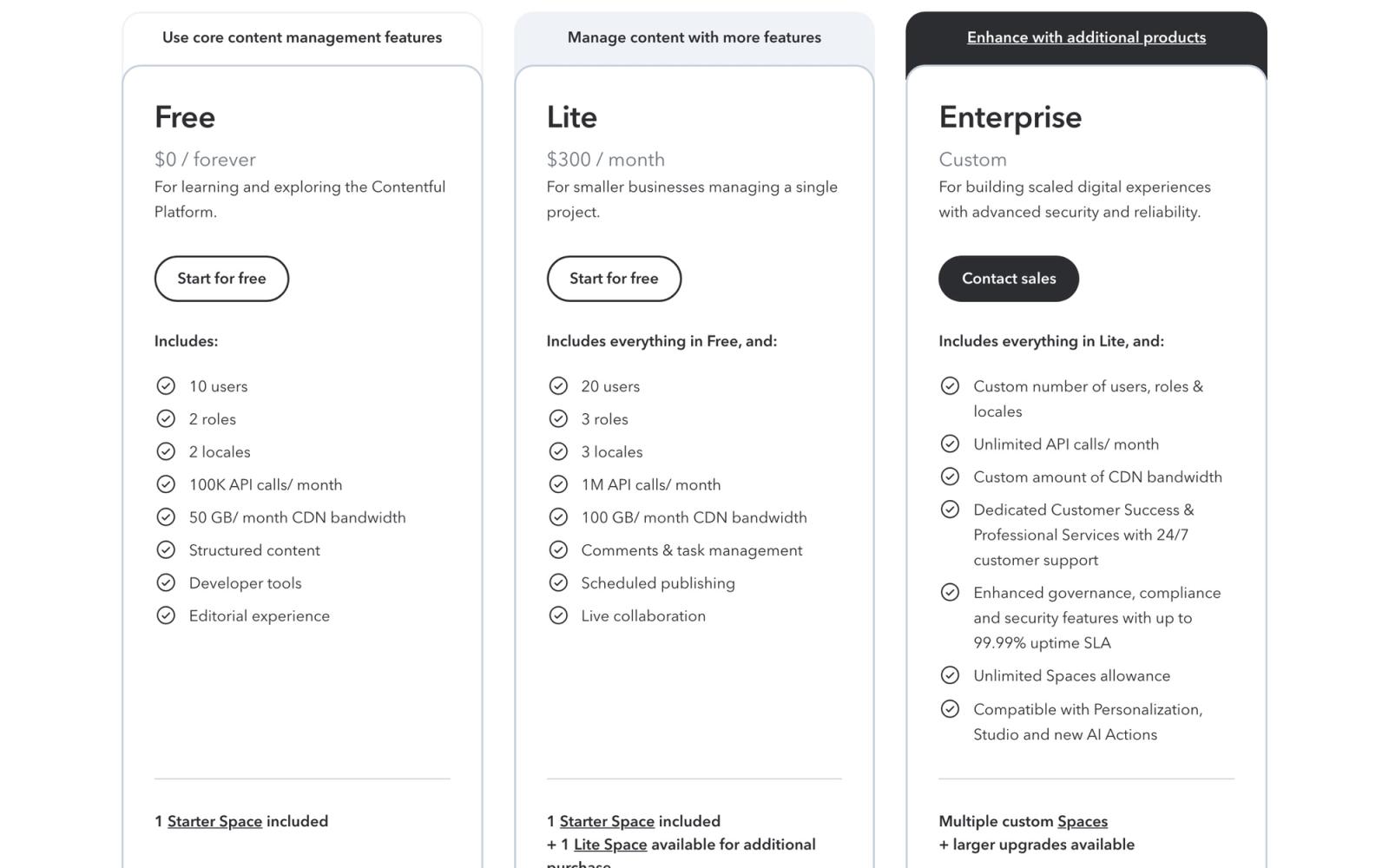
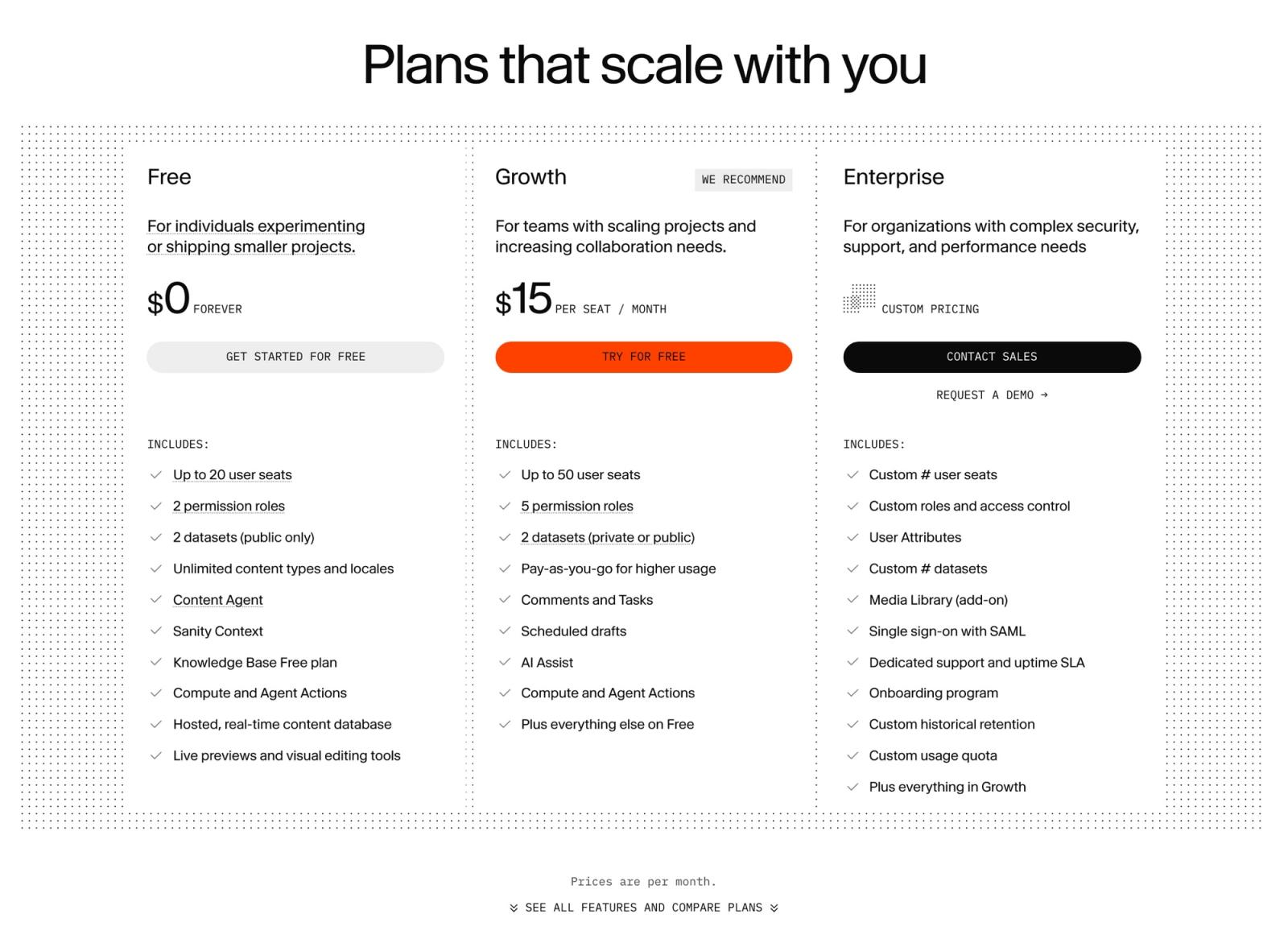
Bottom line: under 20 people Sanity costs less, at about 20 the two match, and past 20 Contentful moves to a quote.
The quota that decides it: content types
Every kind of thing your site stores is a content type: an article, an author, a case study.
On a site with a page builder, each kind of section usually gets one too, because editors pick sections from a list and each section has its own fields. Here is what each plan allows:
- Contentful, technical limit: 1,000 content types per environment, set in its developer docs.
- Contentful Free and Lite: 25 on the included Starter Space, per its pricing page.
- Contentful Lite Space: 50, as an $850-a-month add-on to Lite.
- Sanity: unlimited on every plan, Free included, per its pricing page.
Our content model, counted
We counted our schema in code and the documents in our production dataset on November 20, 2026:
Modeled the usual way in Contentful, each section becomes a content type of its own that the page links to. Our 15 document types and 47 section types in use then come to 62.
That is over the 25 on Lite's Starter Space and over the 50 on the Lite Space, which leaves Enterprise.
The count also leaves out items nested inside sections, like the cards in the schema further down. Contentful would store those as entries of their own type or as JSON.
A Contentful developer would bring that number down. Contentful has a JSON object field that stores any structure, so similar sections could share one content type with a variant setting.
That saves types, but editors get a generic form or raw JSON where they had fields built for the section.
Bottom line: on Contentful, your plan limits how many kinds of sections editors can choose from.
What our site would need on Contentful
Our request numbers come from Sanity's usage dashboard on October 21, 2026, three weeks into the month.
Our pages are prerendered and cached for up to 24 hours, so most visits never reach the CMS. A Contentful build would send a different mix of requests, so read that row as an order of magnitude.
Bottom line: the content-type row decides it anyway. Our site costs $0 a month on Sanity and would need a Contentful Enterprise contract.
Who changes the content model
In Sanity: in code, often written by an AI agent
In Sanity the schema lives in code.
When we add a section type, it's written in TypeScript and goes through review with the rest of the code. Editors see it in the Studio after the next deploy.
These days an AI coding agent writes most of ours. We describe the section, and the agent adds the schema, the component that renders it and the query that fetches it, in one change.
A person reviews that change before it ships. Here is the start of one of our 52 section types, trimmed:
In Contentful: an admin, in the web app
In Contentful an admin adds a content type or a field in the web app, and editors can use it straight away, with no deploy. That suits a team with no developer on call.
The trade: model changes happen outside your codebase, where code review, version history and a coding agent working in your repo don't see them.
Day-to-day editing tools
These are closer:
- Real-time editing and presence: Sanity lists both on every plan. Contentful lists live collaboration and a presence indicator from Lite up.
- Comments, tasks and scheduled publishing: on Contentful Lite and on Sanity Growth.
AI features, and what the Salesforce deal changes
AI features
- Sanity: Content Agent, Agent Actions and 1,000 AI credits a month on every plan, Free included, then $0.05 per extra credit on Growth.
- Contentful: its pricing page lists AI Actions on Enterprise plans only.
We let AI agents edit our site through Sanity's API with access tokens, and tokens don't take a seat.
The Salesforce deal
Salesforce announced the Contentful deal on June 1, 2026 and completed the acquisition on September 1.
Its announcement makes Contentful the content layer of Salesforce's Headless 360, working alongside Data 360 and Agentforce.
If your company already uses Salesforce, that puts Contentful on the shortlist. If it doesn't, the plans and quotas above are what you sign today: Contentful's pricing page on November 20 still showed Free, Lite at $300 and Enterprise on a quote.
Where Sanity pinched on our build
With Sanity, your team builds the connection between the CMS and the site. These are the problems we hit in our first five months, and what fixed each:
- Edits didn't reach the live site → refresh only the changed page. Our webhook pointed at a Vercel deploy hook, so every save started a full rebuild, teardown-tool saves included, while pages kept serving cached content. Since November 17 it hits a route that refreshes just the changed page and skips tool-written documents. Edits now appear in about 11 seconds, with no deploy.
- A just-published page could show the old version → read past the CDN. Sanity's API CDN can lag a publish for a moment, and our refresh fired inside that window. Server-side reads now go to the API directly (
useCdn: false). That draws on Sanity's smaller uncached quota, so check it if your traffic is high. - Every new section needs a code change → editors build any page from our 52 section types, but a 53rd needs code and a deploy. An AI agent writes most of that code now, and a person still reviews and ships it.
- The Free plan has two roles → Administrator or Viewer works for one editor, and it's the first limit a growing team hits.
The first two came from our front end, and a Contentful build needs the same webhook and caching work. Our Labs write-up of the move covers the rest of the rebuild.
Moving from Contentful to Sanity, or back
Both store content as structured data behind an API, so the content itself exports cleanly in either direction. The work is the model:
- Contentful → Sanity: content types become schemas in code, the editing setup gets built in the Studio, and front-end queries move from Contentful's REST or GraphQL APIs to GROQ or Sanity's GraphQL API.
- Sanity → Contentful: Sanity's nested objects have to fit into entries and references, and the whole model has to fit the content-type quota above.
Plan it as a rebuild of the model and the front end, and keep the old CMS live until the new one has every page.
We do these builds as a Sanity agency. Our Webflow to Sanity migration page shows how we scope one.
Sanity or Contentful: which one should you pick?
The practical rule: if your content model changes in code, written by a developer or an AI coding agent, pick Sanity. If it's an admin who needs changes live without a deploy, pick Contentful.
For a single marketing site that a few marketers edit, compare both against a website builder first:
- Our Webflow vs Sanity guide covers that choice from the Sanity side.
- Webflow vs Contentful covers the Contentful side.
- If you're still building a shortlist, our Next.js CMS comparison adds Payload, Storyblok, Strapi and Prismic.
Frequently asked questions
Is Sanity cheaper than Contentful?
For teams under 20 people, yes. Sanity Growth is $15 per seat a month, so 10 editors and a developer pay $165 against $300 for Contentful Lite.
At about 20 people the two cost the same, and past 20 Contentful needs an Enterprise quote. Sites with many section types can need Contentful Enterprise much earlier, because of its content-type quota.
Who owns Contentful?
Salesforce. It announced the deal on June 1, 2026 and completed the acquisition on September 1, 2026. Contentful's pricing page still lists its Free, Lite and Enterprise plans.
How many content types does Contentful allow?
Contentful's technical limit is 1,000 per environment, but plans cap it lower:
- 25 on the Starter Space included with Free and Lite
- 50 on the Lite Space, which costs $850 a month on top of Lite
- Custom quotas on Enterprise spaces
Sanity has no content-type limit on any plan.
Is Sanity free for a team?
Sanity's Free plan covers:
- Up to 20 seats
- 10,000 documents
- 1 million CDN requests a month
- Unlimited content types and locales
Its limits are two roles, Administrator and Viewer, and two datasets that are public: anyone with your project ID can read published content. Private datasets start on Growth.
Can you migrate from Contentful to Sanity?
Yes. Contentful exports content as JSON, and Sanity imports it once the schema exists in code. The time goes into:
- Rebuilding the content model
- Setting up the Studio for your editors
- Rewriting the front-end queries in GROQ
We build sites on Sanity and move teams onto it from Webflow and other CMSs. If you're choosing between the two for a specific site, tell us who edits it and we'll tell you which one we'd pick.
Share the Article


Sanity or Contentful for your site?
We build on Sanity and our own site is on it. Tell us who edits your site and we'll tell you which one fits.
See Khod First on Google
Evgenii Tilipman is the founder of Khod, a digital agency helping B2B tech companies turn their websites into demand-generating assets.
He works closely with founders and GTM teams to define positioning, structure high-converting pages, and build scalable Webflow systems that support growth.
Before founding Khod, Evgenii led Webflow development at an agency and worked with Memberstack to build products for the Webflow community. He has since supported teams from seed to Series C across positioning, conversion, and Webflow development.
Outside of work, he's a husband, dog dad, and someone who treats his health and long hikes with the same consistency he brings to his projects.
Table of Content
Sanity or Contentful for your site?
We build on Sanity and our own site is on it. Tell us who edits your site and we'll tell you which one fits.
See Khod First on Google
Explore Related Articles

Sanity • Oct 20, 2026 • 11 min read
What Is Sanity CMS? How It Works and What It Costs in 2027
Sanity • Oct 20, 2026 • 10 min read
Sanity Pricing in 2027: Plans, Overages and Monthly Bills
Tool Comparisons • Oct 7, 2026 • 18 min read
Next.js CMS: Choosing a Headless CMS for Your Next.js Marketing SiteYour Next Deal Starts With Your Website
Most deals are won or lost before your sales team gets involved. Let's make sure your site is ready for that moment.
