
Resource Center / Articles / What Is Sanity CMS? How It Works and What It Costs in 2026
What Is Sanity CMS? How It Works and What It Costs in 2026
 Evgenii Tilipman • Sanity • Published on Oct 20, 2026 • Updated on Oct 20, 2026 • 11 min read


TL;DR
khod.io runs 180+ pages and 596 documents on Sanity, and pays $0 a month for it. What is Sanity CMS? A headless CMS: a hosted database for structured content, an open-source editing app your developers shape in code, and an API that sends the content to whatever builds your site.
- How it works: content lives in Sanity's Content Lake as JSON documents, editors work in Sanity Studio, and the site pulls content with a query language called GROQ.
- Who it suits: teams with a developer who owns the content model, and editors who build pages from the sections that developer creates.
- What it costs: Free for up to 20 seats and 10,000 documents, then $15 per seat a month on Growth. Enterprise is quoted.
- What to watch: Free has hard caps that block the API at its limits, and every new project's 30-day Growth trial ends on its own and turns non-admin users into Viewers.
- Where it pinches: a new section type is a developer's job, and extra datasets cost $999 a month.
You've heard Sanity mentioned in the same breath as Next.js, Contentful and "headless", and the homepage calls it a Content Operating System. Neither tells you what your team would do in it each day, or what it would cost.
We rebuilt khod.io on Next.js and Sanity in June 2026 and have run it there since, so this guide explains Sanity with our own project as the example: how the parts fit together, what our editors and agents do in it, what we pay, and where it pinches. Prices were checked against Sanity's pricing page and plan docs on October 20, 2026.
What is Sanity CMS?
Sanity is a headless CMS. It stores your content and serves it through an API to whatever renders the website, such as a site built with Next.js or Astro. The website is a separate build: your developers make it, and Sanity supplies the content and the screen your team edits it in.
Sanity launched publicly in November 2017, works out of Oslo and San Francisco, and raised an $85M Series C in May 2025. It calls the product a Content Operating System because the same content can feed a website, an app or an AI agent, from one place.
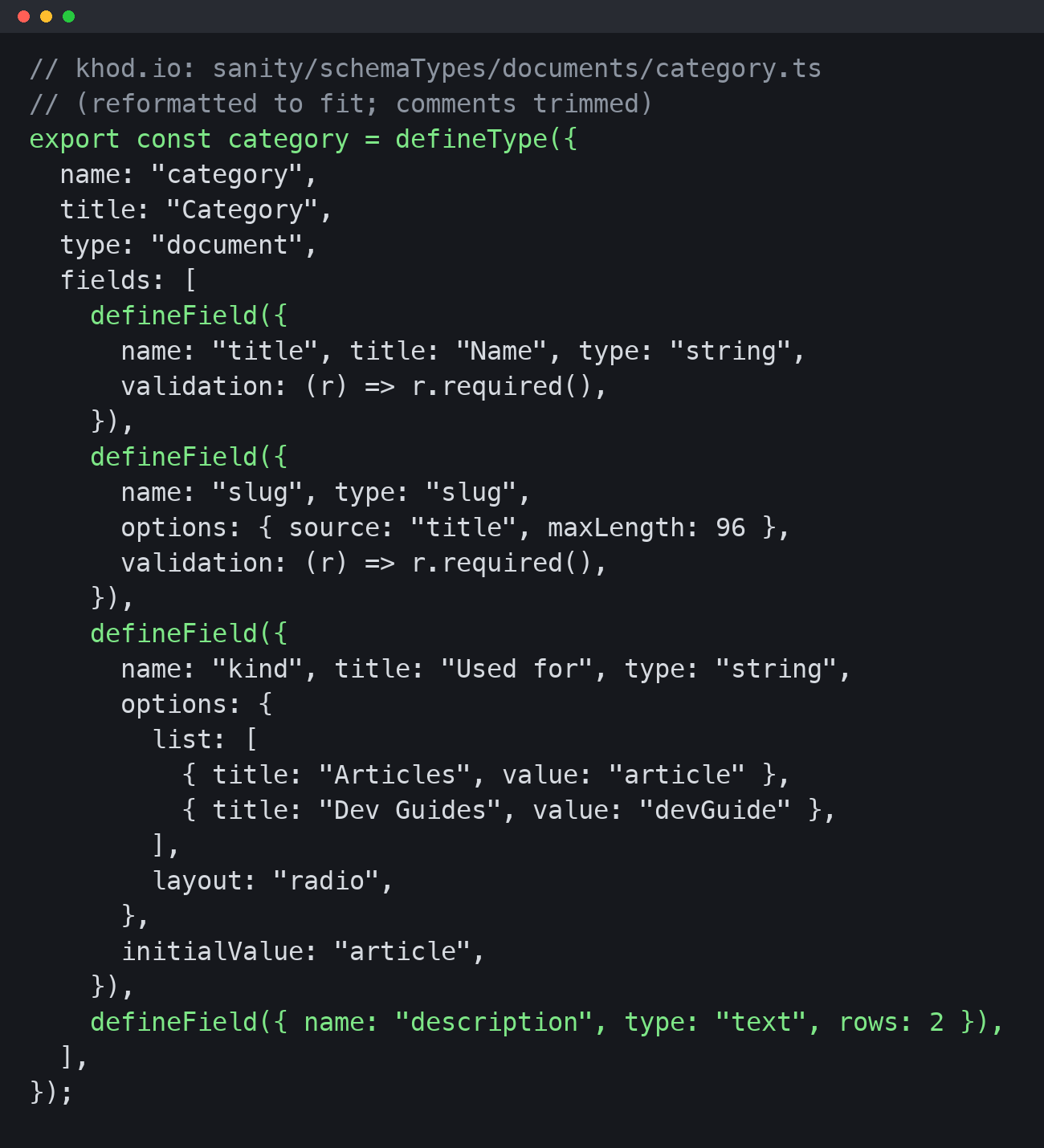
What sets it apart from other headless CMSs is where the content model lives. In Contentful and Storyblok, content types are set up in the vendor's web app by default. In Sanity, a developer defines them in code, in the same repository as the website, and the editing app is built from that code.
This is the whole schema behind the categories on khod.io's resource center. The Studio turns it into an edit form with a required name, a slug generated from it, and a radio choice between articles and dev guides; adding a field is a code change.
How Sanity works
Sanity has four parts.
The Content Lake: where the content lives
The Content Lake is Sanity's hosted database. Every page, post, author or setting is a JSON document, and documents reference each other the way a page references its author. Your team never runs a server or a backup job for it. Sanity serves the content two ways: through a CDN, which is fast and cheap per request, and through an uncached API for anything that needs the latest draft, such as live preview.
On khod.io the Content Lake holds 596 documents across 15 types, from articles and case studies to the reports our website teardown tool writes. Images and files sit next to them as assets.
Sanity Studio: where editors work
Sanity Studio is the editing app. It's an open-source React app under the MIT license, and your developers configure it in code: which fields a page has, which sections editors can add, what the sidebar shows. You can host it free on a sanity.studio address or inside your own site. Ours runs at khod.io/studio.
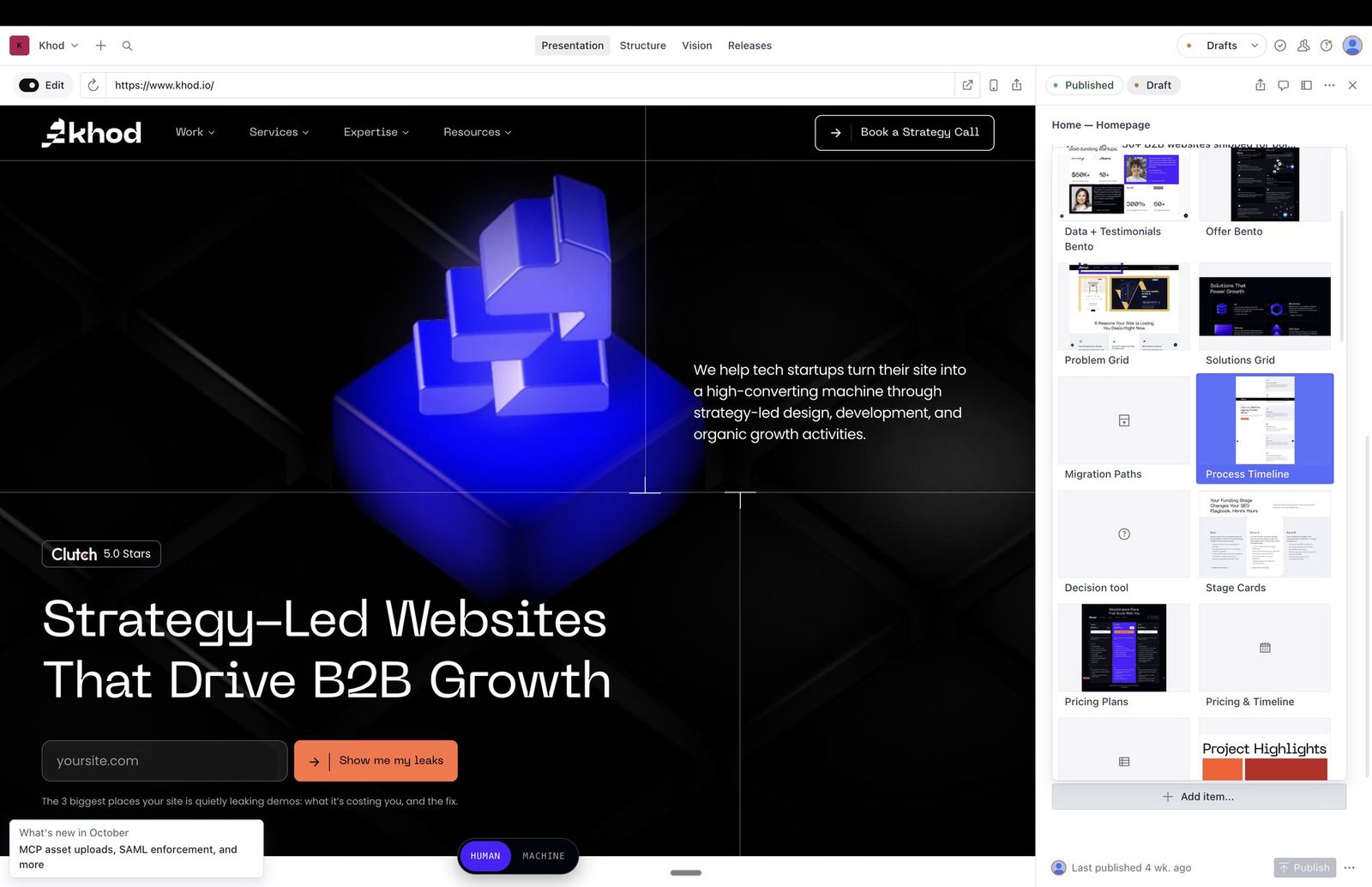
The Presentation tool puts the live site next to the Studio. An editor clicks a heading on the page and lands on that field, edits it and sees the change in place. It's included on every plan, Free too. Pages on khod.io are assembled there from about 50 section types we built once; adding a section to a page means picking it from the list.
GROQ: how the site asks for content
GROQ, short for Graph-Relational Object Queries, is the query language your developers use to pull content out of the Content Lake. A query names the documents it wants and the fields to return, in one request. This is close to the one that fetches this article:
*[_type == "article" && slug.current == $slug][0]{ title, body, author->{ name } }
The arrow follows a reference, so the author's name comes back with the article. Editors never see GROQ; it decides how many requests the site makes, and so what it uses of Sanity's request quotas.
Portable Text: rich text as data
Sanity stores rich text as Portable Text, a JSON format that stores each paragraph, heading and link as structured data. The same text can render on a website, in an app or in a plain-text feed, and custom blocks sit inside it. Every table, image and the cost calculator in this article is a block inside one Portable Text field.
Features your editors use
- Real-time editing. Two people can work in the same document at once and see each other's changes, on every plan.
- Visual editing. Click-to-edit on the live page through Presentation, on every plan.
- Comments, tasks and scheduled drafts. Review and timed publishing for a single document, from the Growth plan up.
- Content Releases. Publishing many documents together on a schedule, for a launch or a campaign, on Enterprise.
- Localization. Plans include unlimited locales, but every dataset has a cap on unique field paths, 2,000 on Free and 10,000 on Growth, and storing every language in every field adds paths quickly.
- AI. Content Agent is on every plan, AI Assist starts on Growth, and plans include 1,000 AI credits a month (5,000 on Enterprise).
How we run khod.io on Sanity
We rebuilt khod.io on Next.js and Sanity between June 16 and July 4, 2026: 180+ pages, built mostly by agents. Four months in, this is what the setup looks like from Sanity's side.
- Editors build pages from sections. Marketing assembles and rewrites pages in Presentation. A new section type is a build, done once, and then it's in the list for every page.
- Agents edit through API tokens. Our agents create drafts, fix copy and add links through an API token, and the site reads drafts for preview through a second one. Tokens don't take seats, so the project uses one human seat out of 20.
- Tools write content too. 222 of our 596 documents are teardown reports a visitor's request created. At about 65 a month, that tool alone would take more than ten years to fill the 10,000-document cap.
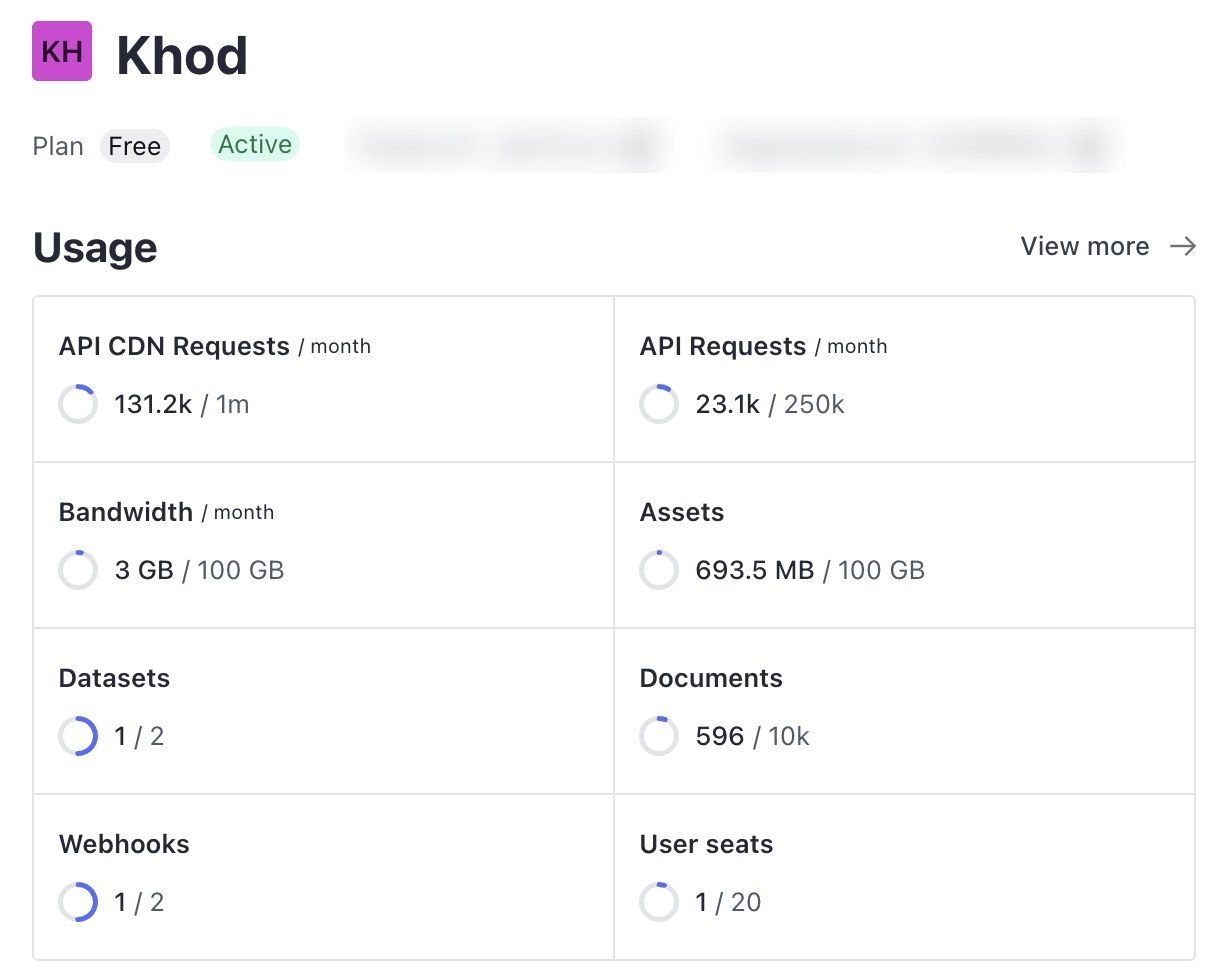
- Pages are prerendered and cached. A visitor reads a cached page, and the site only asks Sanity for content when a page rebuilds. Three weeks into October that meant 131,200 of 1M CDN requests, 23,100 of 250,000 uncached API requests and 3 GB of 100 GB bandwidth.
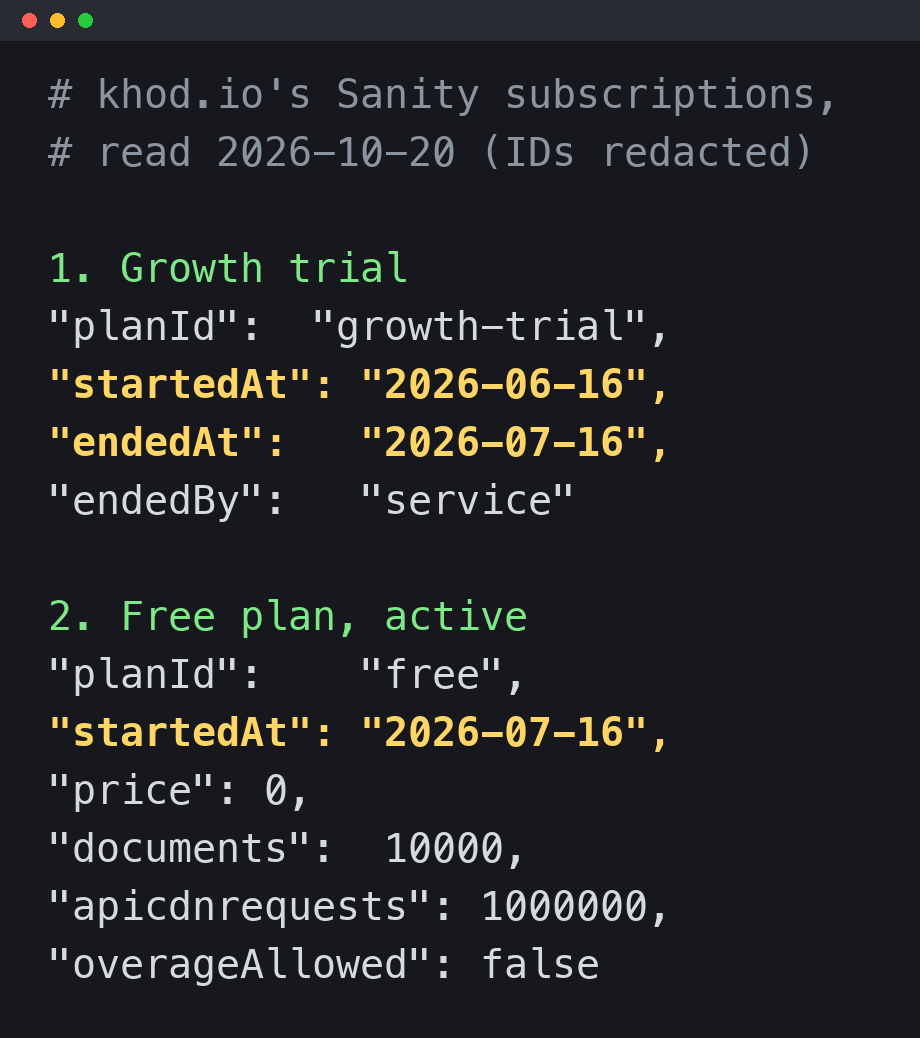
The trial changed nothing for us. Creating the project started a 30-day Growth trial on its own; we never entered a card. Sanity's records for our project show it ended on July 16 and moved us to Free. Our only dataset was public from the start and our one user is an Administrator, so the downgrade had nothing to take away.
What Sanity does well, and where it pinches
It does well:
- Structured content you can reuse. A case study's client, numbers and quote are fields, so the same document fills the case study page and the case study section on our homepage without anyone copying text.
- An editing app shaped around your team. The Studio shows the fields and sections your editors need, named the way they talk.
- Visual editing on every plan. Click-to-edit in Presentation costs nothing extra, Free included.
- Nothing to host for the content. The Content Lake, the CDN and the Studio's hosting are Sanity's job.
- Easy for scripts and agents to write to. Everything is an API call, which is how our agents edit khod.io.
Where it pinches:
- A developer owns the model. Editors arrange the sections a developer defined. A brand-new layout is a build.
- Free has two roles. Every Free user is an Administrator or a Viewer, so anyone who edits can also change settings and delete datasets.
- Hard caps on Free. At a monthly limit Sanity blocks the API with an HTTP
402error, so builds, previews and any page that queries Sanity live fail until the month resets. - Datasets are expensive. Two are included; each extra one is $999 a month on Growth.
- Your content lives on Sanity's servers. You can export a dataset with the Sanity CLI, but the Content Lake itself can't be self-hosted.
What teams build with Sanity
Two sites we've built show the range. khod.io is a 180+ page marketing site with a resource center, case studies and lead tools that write their results to Sanity. The Accountant Quits, a podcast's 118-page Astro site, stores episodes, guests and companies as linked documents, which Sanity references connect: an episode points to its guest, and the guest to their company.
The same pattern fits documentation, product catalogs and apps that share content with a website: anything where one piece of content appears in several places and has to stay consistent.
How much does Sanity cost?
Sanity sells three plans. The figures below come from Sanity's pricing page and its plans and payments docs, read on October 20, 2026.
Seats are the predictable part. On Growth every user takes a $15 seat except Viewers, who are free, and API tokens don't take seats. A team of five marketers and a developer pays $90 a month.
Overage rates, add-ons, worked monthly bills and a calculator are in our Sanity pricing guide.
The trial ends on its own. Every new project gets 30 days of Growth features. When the trial ends without an upgrade, private datasets become public and every non-admin user becomes a Viewer, so editors lose edit access on day 31. Before then, add a card and move to Growth, or make the people who edit Administrators.
The CMS is one line of three. The website itself needs a host such as Vercel, whose Hobby tier is for personal, non-commercial use, so a company site belongs on Pro, from $20 a month. Someone also builds the content model, the sections and the preview once; at Khod a Webflow to Sanity migration starts from $5,000.
How Sanity compares
The table prices the cheapest paid plan for a team where 5 or 10 people edit, at monthly list prices from each vendor's pricing page on October 20, 2026. Sanity's Free plan fits both team sizes if everyone can be an Administrator.
On paid plans, Prismic costs least at five editors, at $30. At ten, Sanity does: $150, against $174 on Storyblok, $180 on Prismic and $300 on Contentful. Strapi and Payload can run on your own servers, which costs nothing in licenses and makes hosting, updates and backups your job. Our guide to Next.js CMS options compares how each one handles previews, page building and approvals. The same comparison for Astro sites is in Astro CMS options.
Is Sanity the right CMS for your team?
Whether Sanity fits depends on who builds pages. In Sanity, a developer adds new section types and editors assemble pages from them. A team that works that way gets hosted content, visual editing and up to 20 seats for $0, and more roles at $15 a seat. A team whose marketers expect to design new layouts with no developer will keep paying for developer time, and a visual builder like Webflow suits them better.
If a developer will own the content model for the next year, Sanity is a strong choice and cheap to run. If nobody will, pick a platform your team can run on its own. Our best CMS for SEO comparison covers Webflow, Wix, Squarespace and the other platforms a marketing team can run without a developer.
Frequently asked questions
Is Sanity a headless CMS?
Yes. Sanity stores content and serves it through an API, and the website is built separately, often with a framework like Next.js or Astro. Sanity calls itself a Content Operating System because the same content can feed websites, apps and AI agents.
Is Sanity CMS free?
Yes. Sanity's Free plan costs $0 with no time limit and covers 20 seats, 10,000 documents, two public datasets, 1M CDN requests and 250k API requests a month. Its limits are hard caps, and every user is an Administrator or a Viewer. Growth costs $15 per seat a month.
Is Sanity open source?
Sanity Studio, the editing app, is open source under the MIT license. The Content Lake, where content is stored and served, is Sanity's hosted service, and that's what the plans pay for.
Can marketers use Sanity without a developer?
For day-to-day work, yes: editing, publishing and building pages from existing sections in the Studio's Presentation view. Adding a new type of section or field takes a developer, because the content model lives in code.
Where does Sanity store your content?
In the Content Lake, Sanity's hosted database, as JSON documents. Images and files are stored as assets. You can export a dataset with the Sanity CLI at any time.
How long does it take to set up Sanity?
Setting up Sanity is part of building the site. Our rebuild of khod.io, 180+ pages including the content model and the Studio, ran from June 16 to July 4, 2026. On our project, most of the Sanity work went into the content model; installing the Studio takes minutes.
How long is Sanity's free trial?
30 days. Every new project gets Growth features automatically when it's created. Our project's trial ran from June 16 to July 16, 2026, and moved to Free on its own.
Is Sanity better than WordPress?
They do different jobs. WordPress is the website, the CMS and a plugin ecosystem in one system. Sanity stores the content and leaves the website to a framework your developers build. Sanity suits a team with a developer and editors who work in structured sections; WordPress suits a team that wants themes and plugins in one place.
Is Sanity a good CMS?
For a marketing site with a developer behind it, yes. We run khod.io's 180+ pages on it, on the Free plan, with editors building pages from sections and agents editing through the API. It's a poor fit when nobody on the team will maintain the content model.
Share the Article


Want us to set up Sanity?
We build marketing sites on Next.js and Astro with Sanity behind them, and we run our own site on it. Tell us who edits your site and we'll size the plan before we build.
See Khod First on Google
Evgenii Tilipman is the founder of Khod, a digital agency helping B2B tech companies turn their websites into demand-generating assets.
He works closely with founders and GTM teams to define positioning, structure high-converting pages, and build scalable Webflow systems that support growth.
Before founding Khod, Evgenii led Webflow development at an agency and worked with Memberstack to build products for the Webflow community. He has since supported teams from seed to Series C across positioning, conversion, and Webflow development.
Outside of work, he's a husband, dog dad, and someone who treats his health and long hikes with the same consistency he brings to his projects.
Table of Content
Want us to set up Sanity?
We build marketing sites on Next.js and Astro with Sanity behind them, and we run our own site on it. Tell us who edits your site and we'll size the plan before we build.
See Khod First on Google
Explore Related Articles
Sanity • Oct 20, 2026 • 10 min read
Sanity Pricing in 2026: Plans, Overages and Monthly Bills
Tool Comparisons • Oct 19, 2026 • 19 min read
Astro CMS: Choosing a CMS for Your Astro Marketing Site
Tool Comparisons • Oct 14, 2026 • 13 min read
Astro vs Next.js: Which One Fits Your Website in 2026Your Next Deal Starts With Your Website
Most deals are won or lost before your sales team gets involved. Let's make sure your site is ready for that moment.
