
Khod Labs / Off Webflow
Off Webflow: The Migration, and What Speed Bought Us Since
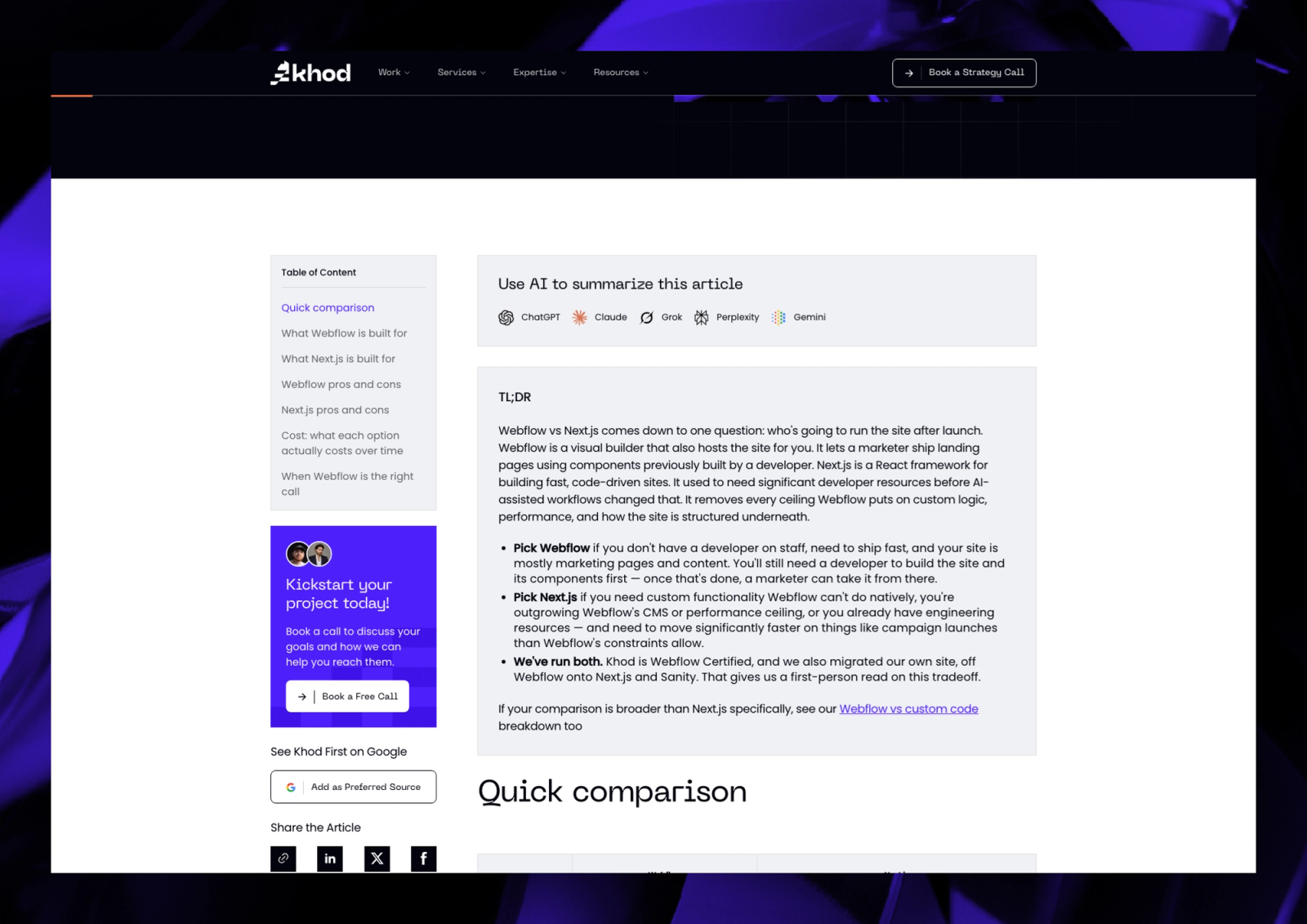
"You can't call yourself innovative and then avoid the technology you'd have to learn to stay that way. So we ran it as a test, on the one site we're free to break. It turned out to be the best thing we could have done for our inbound marketing and for executing our GTM."
Evgenii Tilipman
Founder @Khod

We build on Webflow for a living. We are Webflow Certified Partners, and most of our client portfolio still runs on it. In June 2026 we moved khod.io off it.
The old site ran fine at 31 pages. We moved to test agentic development on the one site we are free to break, before pointing it at a client's.
The migration
We rebuilt khod.io on Next.js and Sanity, agent-driven, start to finish.
- June 16, 2026: first commit, 31 pages ported. Nav, footer, the old CSS, and the client-side behaviors underneath it: sliders, dropdowns, forms, video embeds.
- June 17: the sitemap listed 169 pages.
- July 4: roughly 180 pages live. Under a month, start to finish.
What the speed numbers say
PageSpeed Insights, home page against home page: khod.io on Next.js against the old build still live at tilipmandigital.webflow.io. Median of six runs per site and strategy.
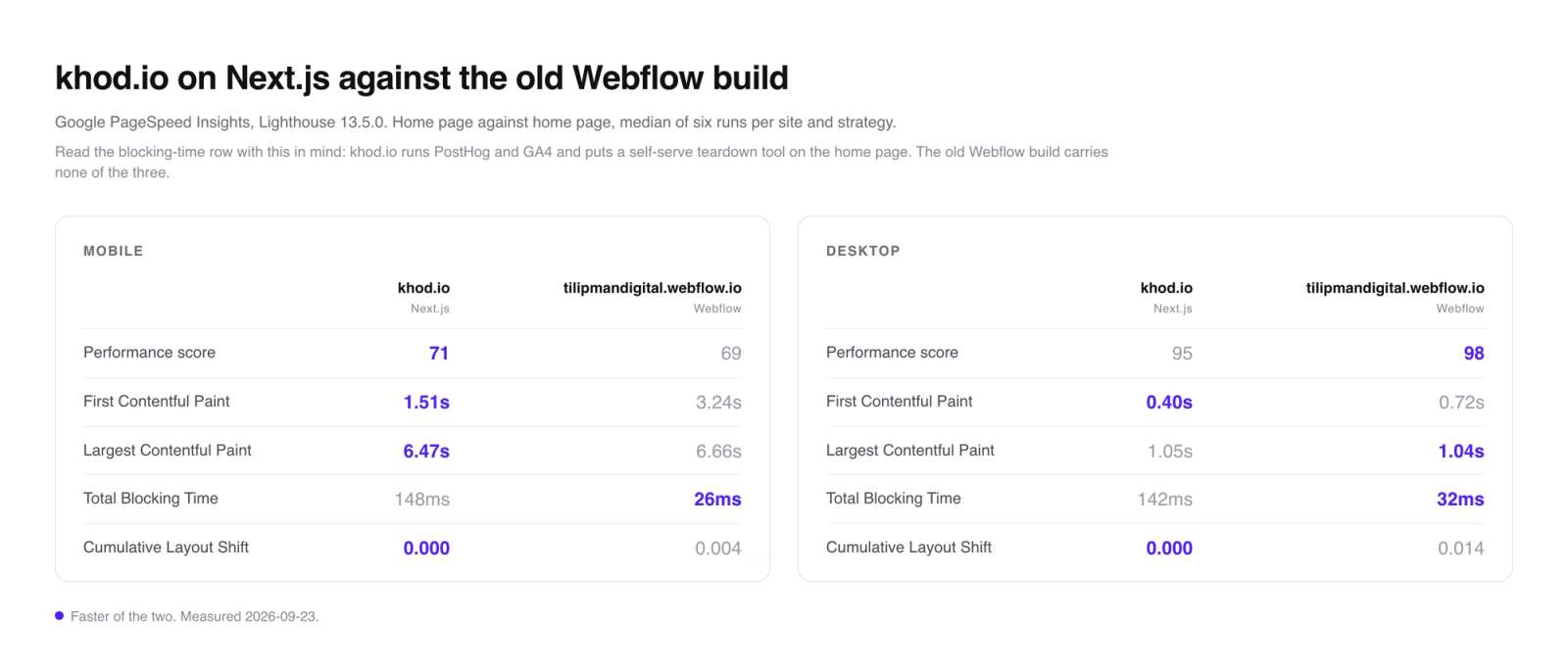
- First paint is the win. Mobile 1.51s against 3.24s, desktop 0.40s against 0.72s.
- Layout shift is 0.000 on khod.io. The old site sits at 0.004 on mobile and 0.014 on desktop.
- Scores land within two points on mobile, 71 against 69, and behind on desktop, 95 against 98.
- Blocking time is the gap: 148ms on mobile and 142ms on desktop, against 26ms and 32ms.
Blocking time is the cost of what the page carries. khod.io runs PostHog and GA4 and puts the teardown tool on the home page. The old Webflow build carries none of the three.
Mobile largest contentful paint is close, 6.47s against 6.66s, and both are slow. The home page hero is the largest element. On this stack that is a change we ship in a week instead of scope.
What shipping without a queue bought
Once shipping stopped requiring a build queue, this landed in the weeks after:
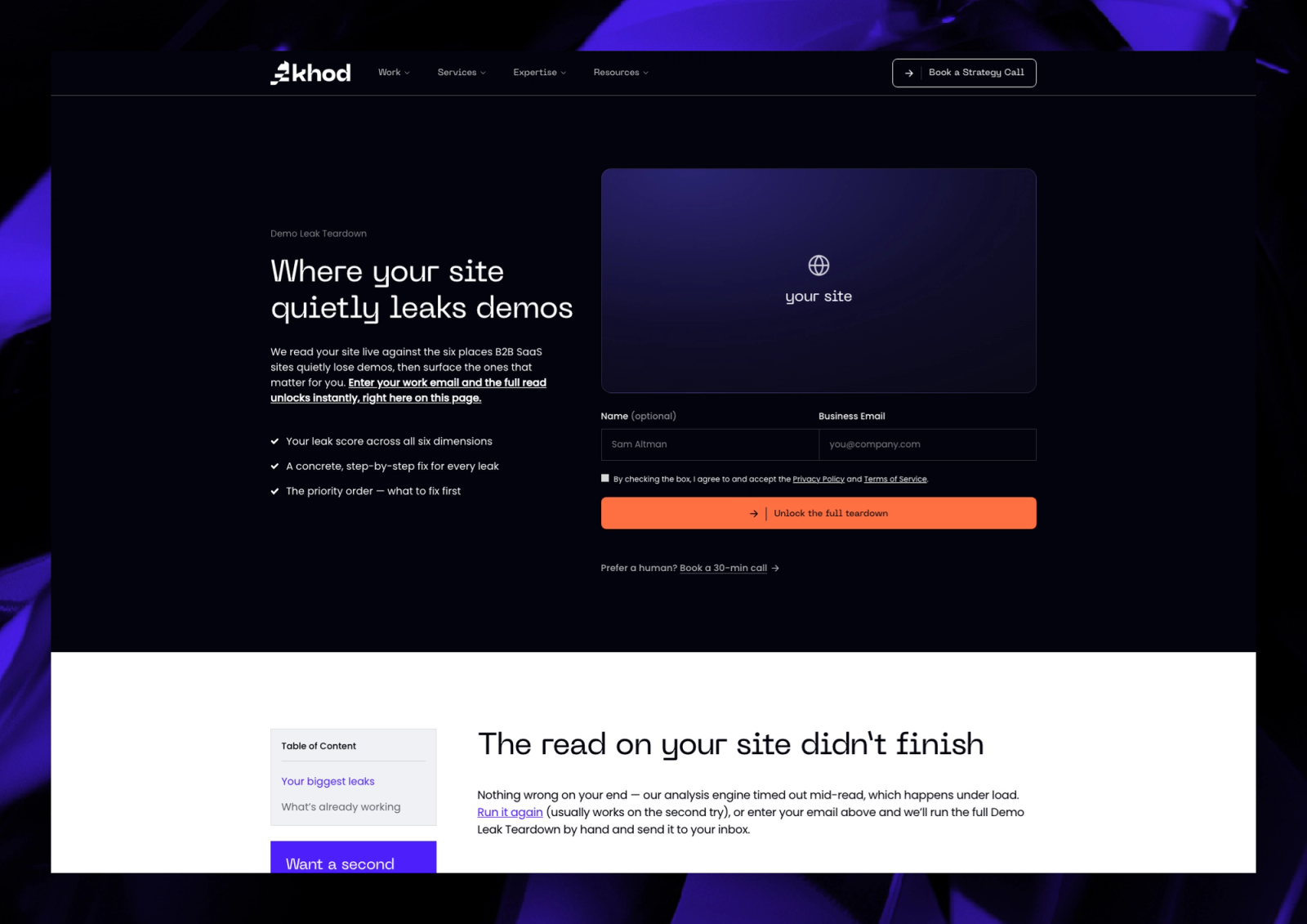
- A self-serve website teardown, live July 7. It scores a site on six automated dimensions and hands a visitor their own leak report before anyone books a call.
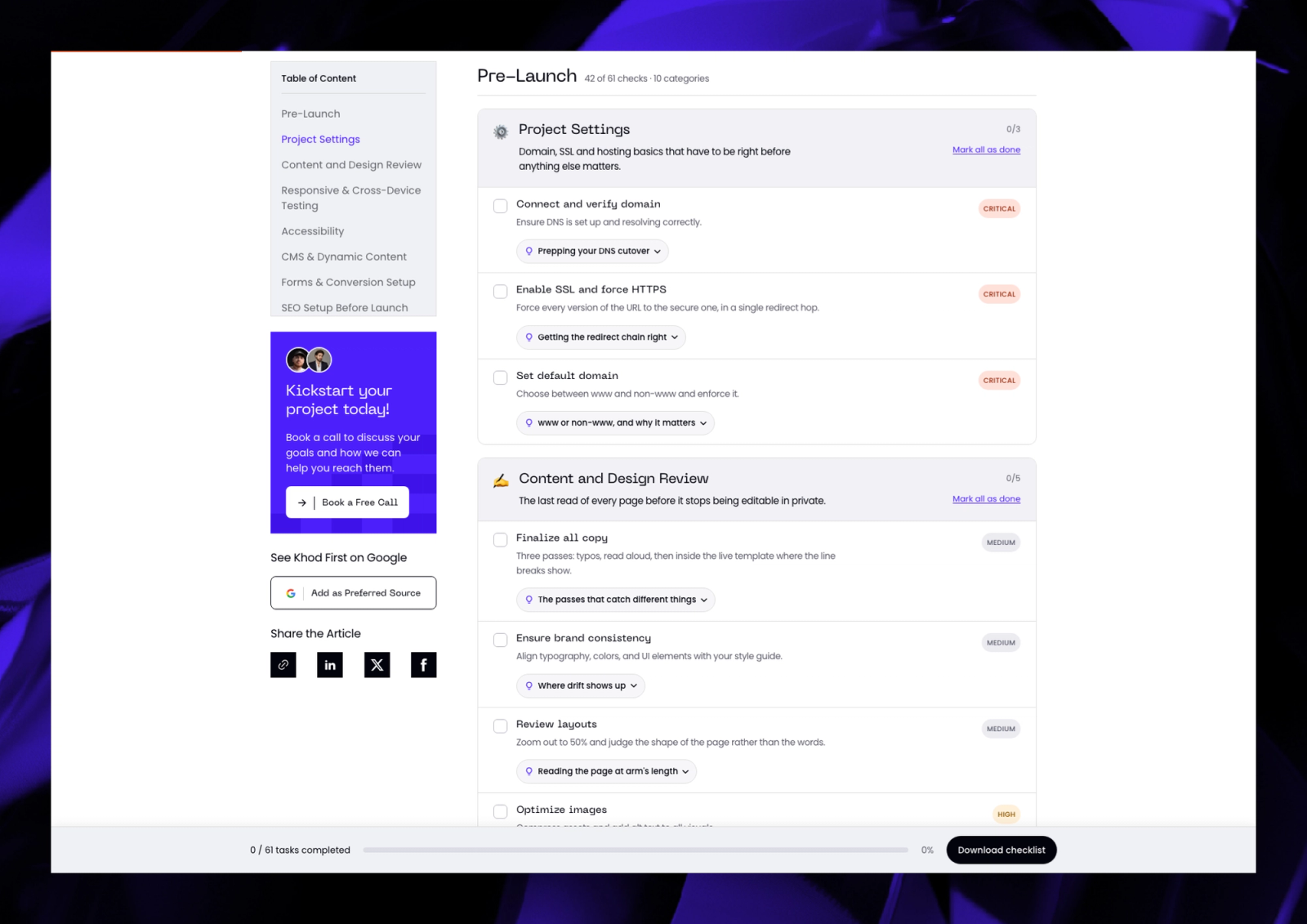
- An interactive website launch checklist, live September 7: 61 checks across 16 categories, the same one we use, saving progress when you leave the page.
- A companion website audit checklist, published September 15: 48 items across 10 sections, 46 of them sourced to a named expert.
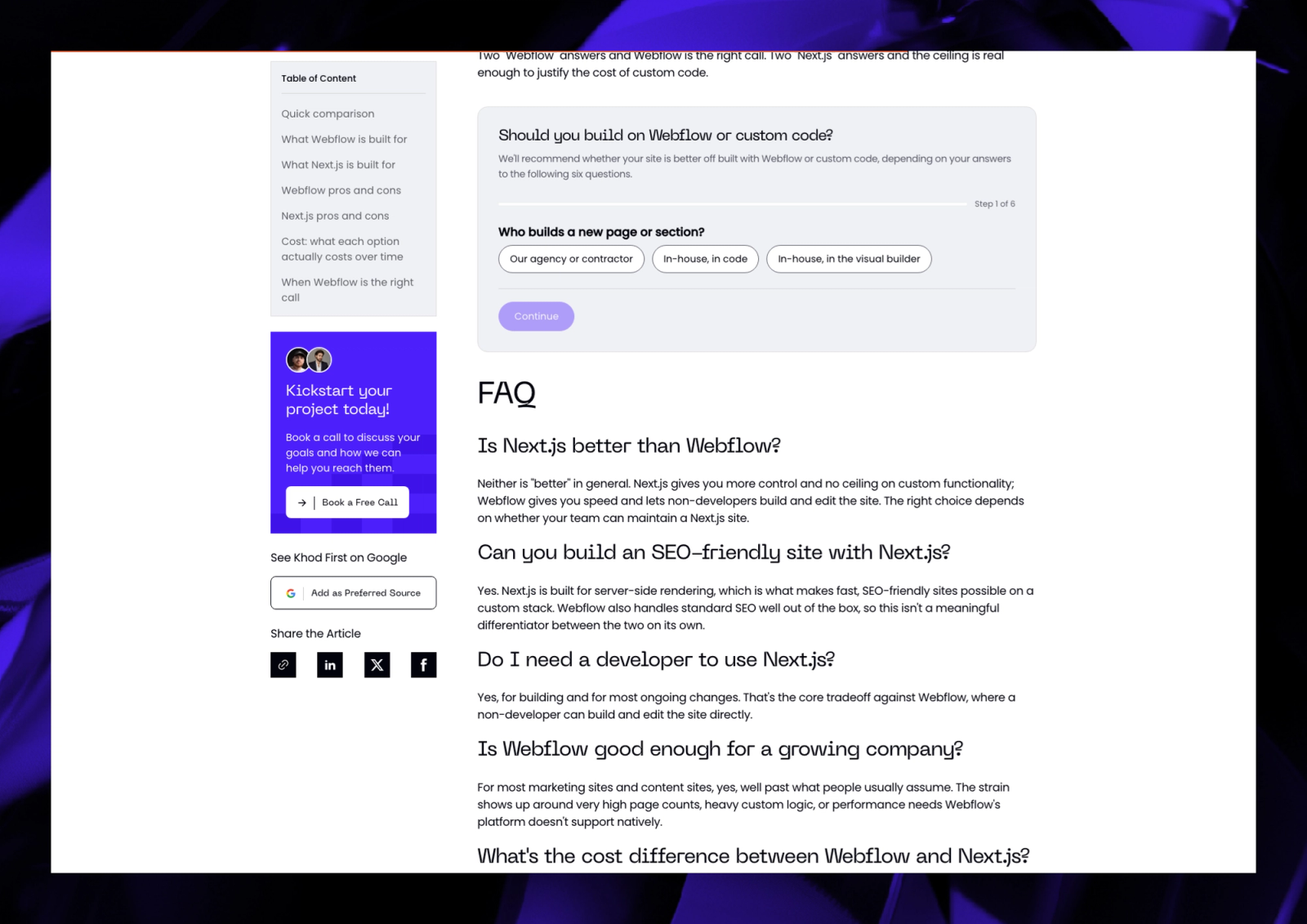
- A “should you move off Webflow” quiz, live September 13. It tells most people to stay on Webflow when that is the answer, and routes a custom-code verdict to our migration page.
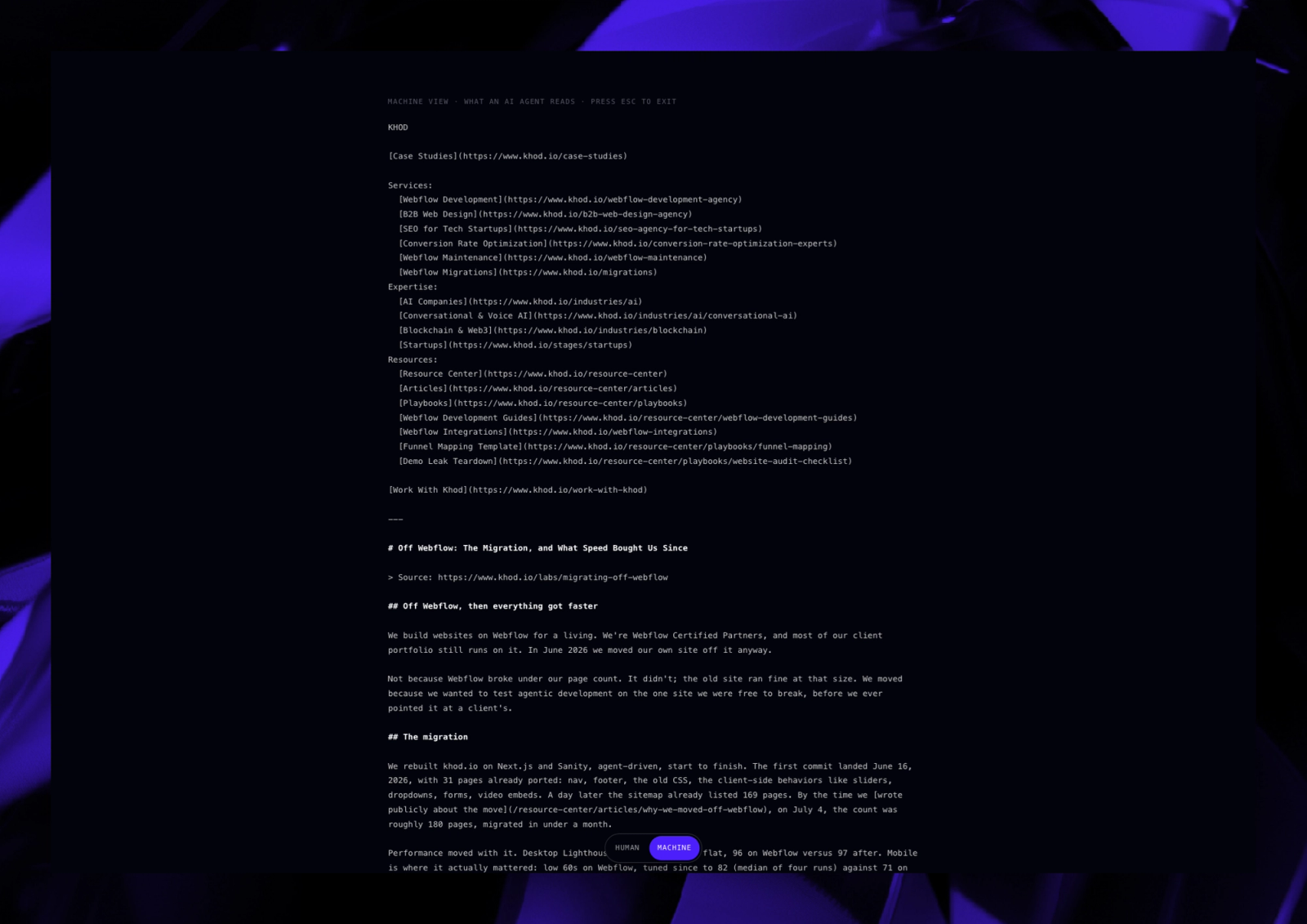
- A human/machine toggle, added to migration pages September 2, that flips a page to the plain-Markdown version a crawler or an AI reads.
On Webflow each of those would have been its own scoped project. On our own stack they shipped about as fast as we could describe them.
Who edits the site now
The question people ask first: who edits a codebase once the developers move on.
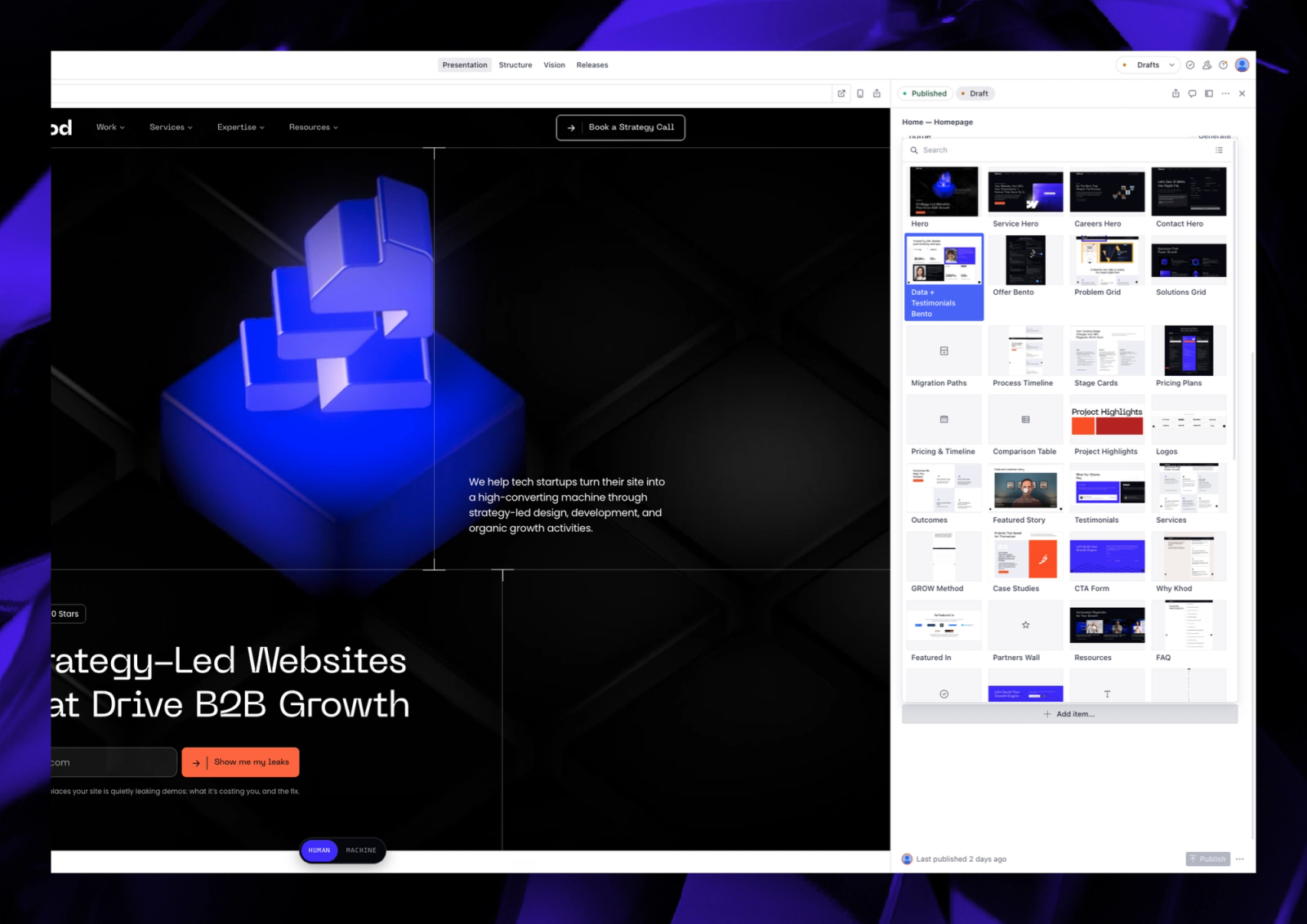
Sanity answers it. Fifty component types, hero blocks, pricing tables, FAQs, comparison tables, testimonials, assembled through a page builder our marketing side drives directly.
- Existing pages get rearranged and rewritten in Sanity Studio, no code touched.
- New page types get built agentically, once. After that, running the site is picking blocks.
- You give up the Webflow canvas. Dragging a brand-new section type into existence becomes a build.
When this is the wrong move
This worked because operating an agentic stack is our job. Hand a codebase to a team that is not fluent in driving agents and a managed platform like Webflow is the safer call. We tell clients that directly.
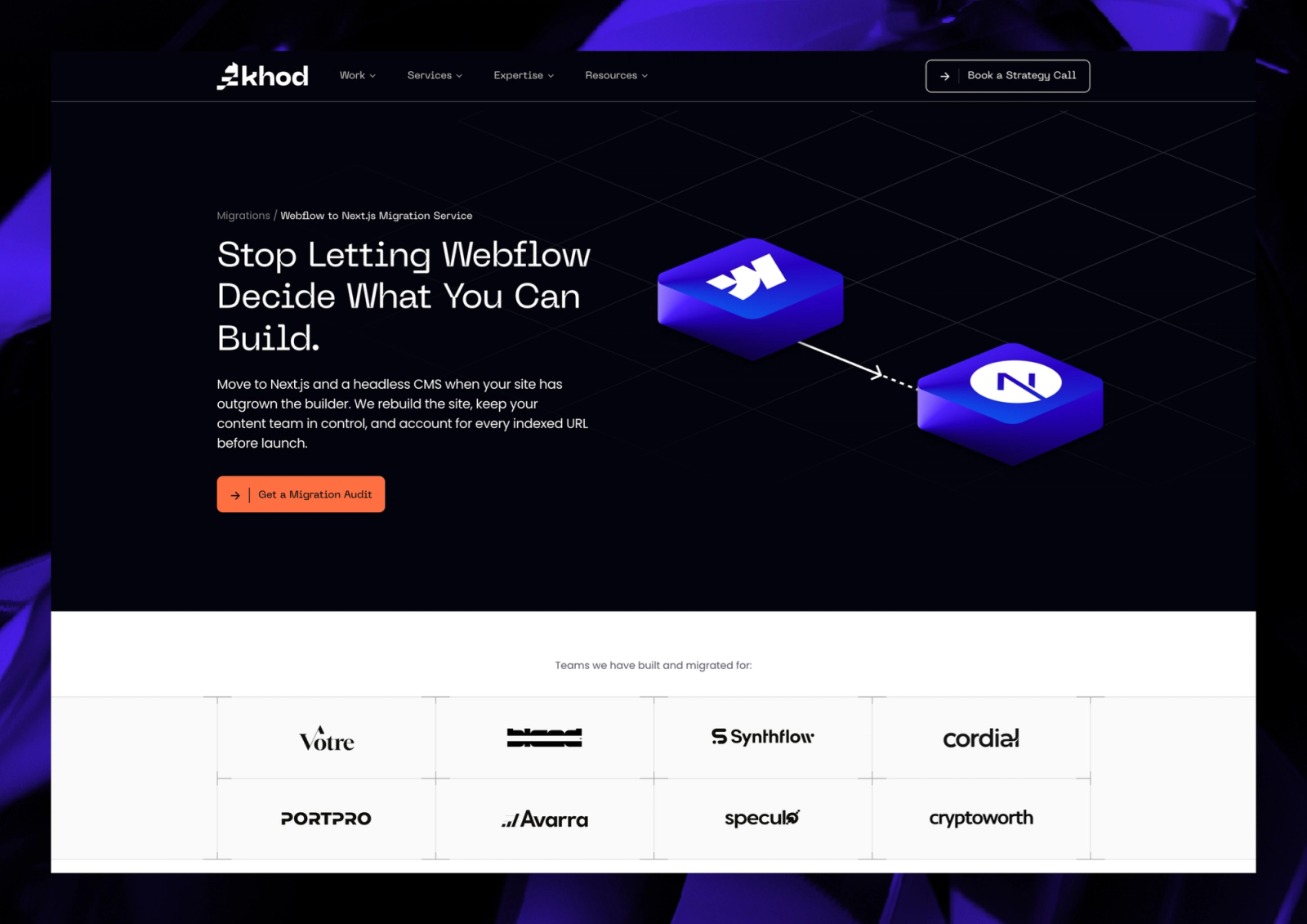
We wanted range the Webflow canvas does not expose, and we were willing to own the stack to get it. If you are weighing the same move, the mechanics are on our Webflow to Next.js migration page.
Where this stands
Three months on, the migration held. We run the same play for clients in both directions, on the migrations hub.
Since June 16, 13 separate things shipped on the new stack: the teardown tool, both checklists, the quiz, and the human/machine toggle above, plus three new case studies, our first signed referral partner, an AEO visibility tracker, a migrations hub, a partners wall, and Khod Labs itself.
Two numbers on the business side:
- Email list. Flodesk subscribers grew 7.6 a month since the migration (25 between June 16 and September 23), against 4.3 a month before it (30 across the prior seven months, setting aside a one-time import of 59 in November 2025). September added 12 in its first two weeks.
- Leads. Analytics started capturing khod.io on June 17, one day into the migration, so there is no before number. Since then: 13 lead-form submissions, 13 teardown requests, 20 playbook downloads, 8 calls booked.
Field Core Web Vitals capture is off by design, and we have not pulled a before/after GA4 comparison. That part of the picture is still missing.
Problem
Webflow's visual builder exposes what the platform chose to expose, and reaches an agent through an MCP bridge that is a bottleneck on top of that. We could not test agentic development at speed, on our own site, inside those limits.
Hypothesis
Owning the stack (code plus agentic dev) would let us ship experiments in days instead of scoped projects, and prove that speed out on ourselves before selling the same migration to clients.
Services
Website Migrations, Webflow to Next.js, Web Development


Kickstart your project today!
Book a call to discuss your goals and how we can help you reach them.
Let’s Build Your Growth Engine
Are you ready to turn your website into a high-performing marketing asset?
