
Resource Center / Articles / Why We Moved Khod Off Webflow
Why We Moved Khod Off Webflow
 Evgenii Tilipman • News & Events • Published on Jul 4, 2026 • Updated on Jul 4, 2026 • 5 min read

TL;DR
We moved Khod's own website off Webflow. The short version:
- What we did: rebuilt our site, roughly 180 pages, on Next.js, Sanity, and agentic development. We still build on Webflow, WordPress, and Framer for clients.
- Why: two reasons. Agentic development lets us ship faster, and it is becoming a real shift we needed to investigate firsthand rather than read about.
- The tradeoff: you can build more with an agentic stack than with a visual builder, but Webflow's managed hosting and security are an advantage; you need a good designer no matter what.
- So far, so good: mobile Lighthouse scores moved from the 60s to the 80s, now ahead of the Webflow build it replaced; desktop was already strong on both and stayed that way. It is early, but the early read is positive.
- The results: three months of numbers, and what the new stack has shipped since, are in Khod Labs.
We build websites on Webflow, WordPress, and Framer for a living. We just moved our own off Webflow.
That sounds like a contradiction, so let me explain it up front. We are Webflow Certified Partners and have no intention of leaving the program, let alone writing “Webflow is dead” hot takes.
We still build on it. Most of our client portfolio is on Webflow, and for many companies, it's still the right choice. What we did to our own site was an experiment. We wanted to test it on ourselves before putting a client anywhere near it. Here's why.
Wondering where your own site is leaking visitors?
The free Demo Leak Teardown scans six spots on your site and shows exactly where people drop off before they book a call.
Two reasons we made the move
The first is speed. Agentic development, where an AI agent does much of the mechanical build work on instruction, is letting us ship changes far faster than we could by hand. We wanted that speed on our own site.
The second is that we had to see it for ourselves. Agentic development is becoming a major market shift. Businesses are already leaving Webflow for it. We would rather investigate a change like that by living it than by reading about it. So we migrated our site, roughly 180 pages.

Where Webflow still wins, and where it does not
We did not leave because our site had gotten too big or complex for Webflow. It handled our roughly 180 pages without trouble.
Webflow's advantage is the managed layer. It is a private company that takes care of your hosting and your security, and for many businesses that is a serious consideration. If your team would rather not own that responsibility, Webflow earns its price.
Where an agentic stack pulls ahead is on what you can actually build. A visual builder gives you what the platform chose to expose, and it reaches an agent through an MCP bridge that is itself a bottleneck. With code, the ceiling is whatever you can describe. Sky's the limit.
Webflow hands you a managed, secure foundation. An agentic stack hands you range.
If you want the fuller breakdown of that tradeoff before you decide anything, our Webflow vs custom code comparison covers the pros, cons, and how to weigh them for your own site.
The real question was what we wanted to build
Here is the reframe that made the decision simple. The question was never “which builder do we prefer.” It was not even “what can an agent operate.” It was “what do we want to build,” and then “what lets us build it.”
Once we asked it that way, the answer pointed at a codebase and structured content. An agent reads and writes code. It can restructure a component, update content across a hundred pages, and fix a schema in one pass. We did not give up the visual canvas entirely, though. We built a visual editor in Sanity that lets us move components around. It is less flexible than Webflow, but new things get built agentically, then managed by pairing the agentic workflow with the CMS as a visual builder.
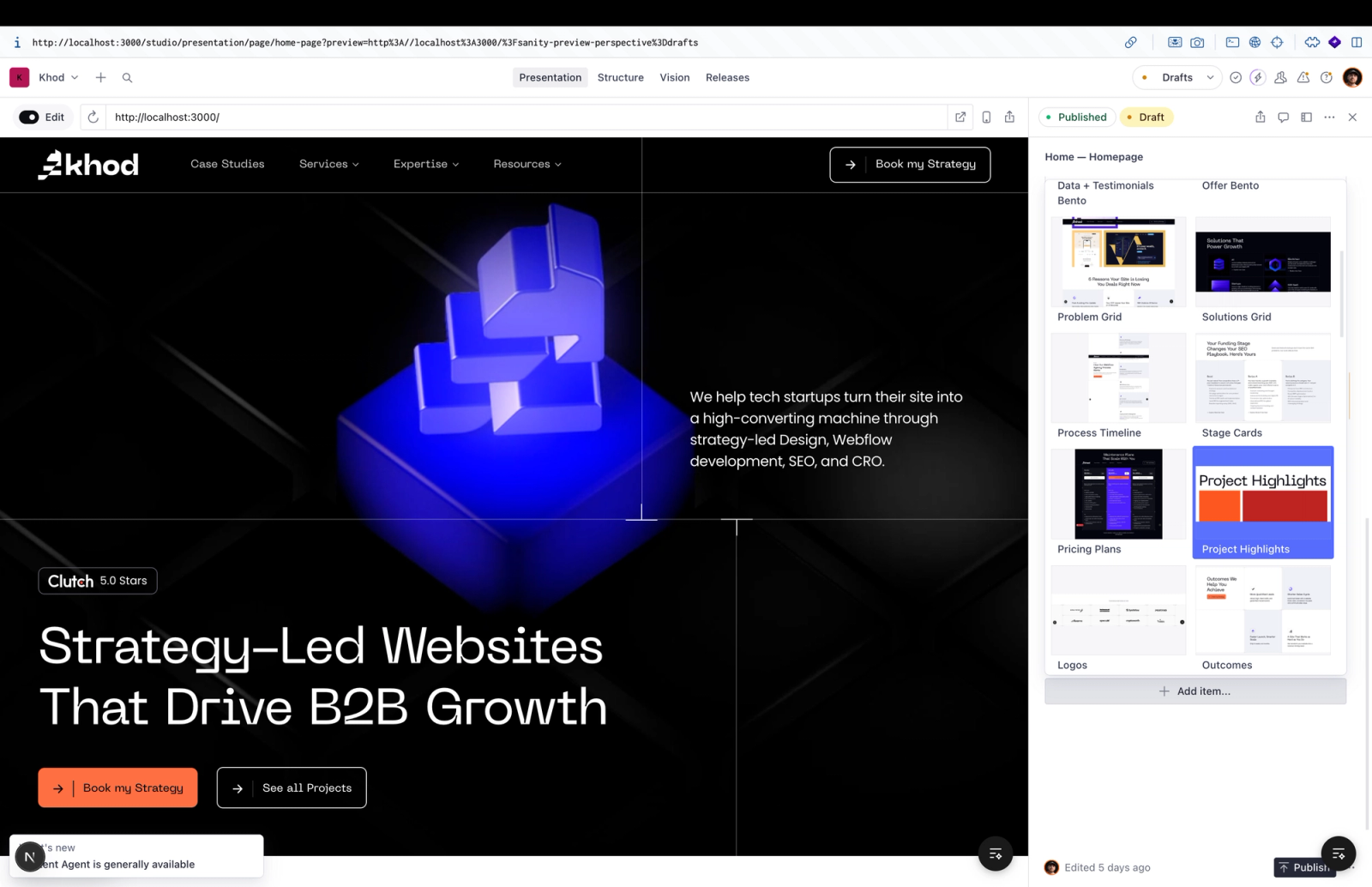
What it cannot do well yet is design. Teaching an agent taste is still an unsolved problem (at least for us), so you still need a good designer driving it. The agent carries the mechanical load. The judgment is still human.
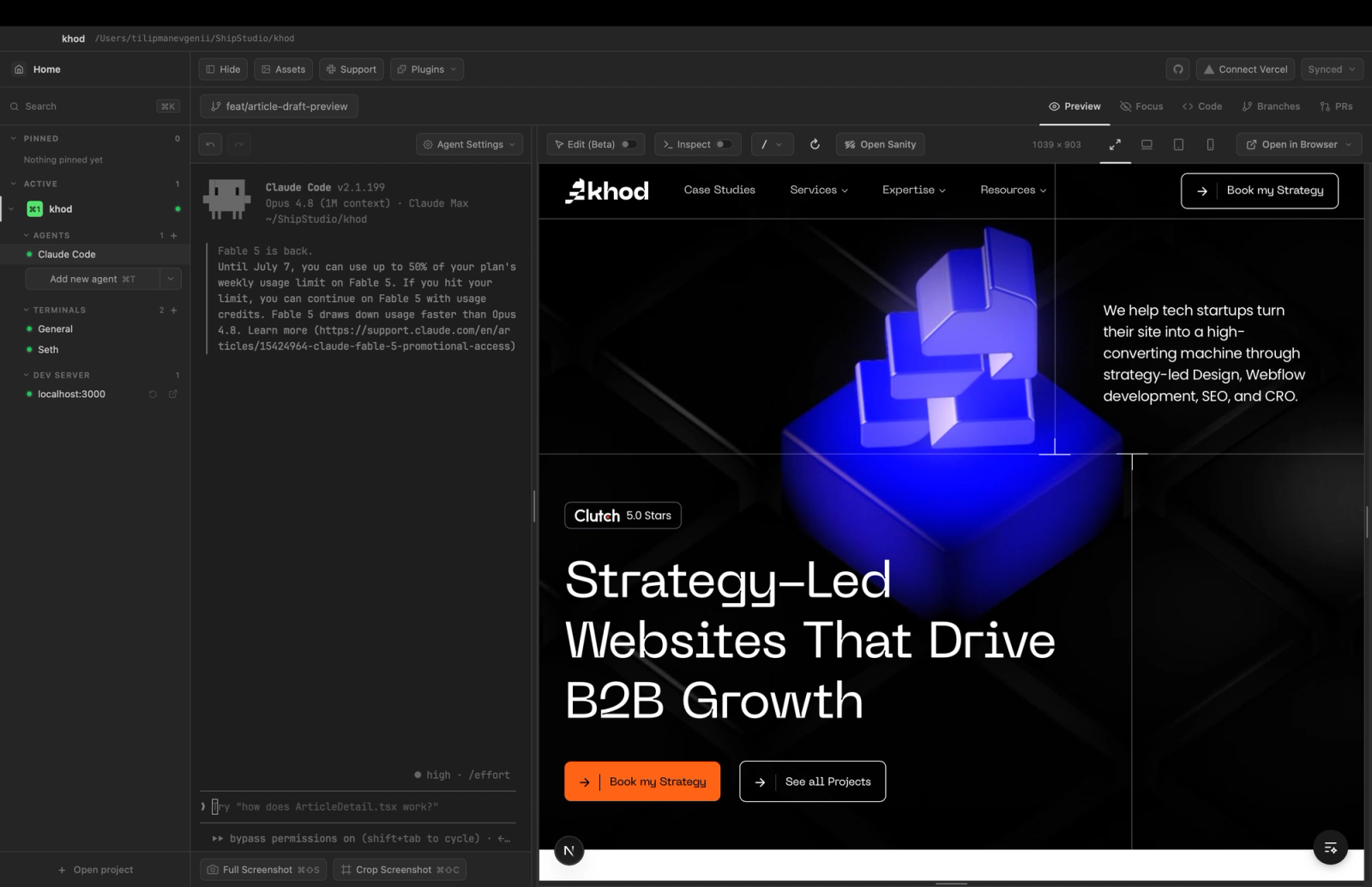
The agentic work itself happens in a terminal. Claude Code runs in a terminal, Codex runs in a terminal, and Ship Studio is the terminal wrapper we chose to run ours in. It is a tool, not the point. The point is that the site became something an agent can build and change on instruction.
The stack, and why we are not precious about it
We rebuilt on Next.js and Sanity. The specific choice mattered less than people assume. We could have picked Astro or another framework and CMS and been fine. Claude recommended this pairing; we had seen Memberstack make the same move, and we needed to start somewhere. So we started here.
To give some context about the stack we chose:
Next.js puts rendering and SEO in our hands: we decide what is static, what revalidates, and what structured data each page emits. We compared it directly against Webflow in our Webflow vs Next.js breakdown.
Sanity holds the content as schema-as-code, which matters the moment you have relationships between content like an integrations library or an article cluster. It can also act as a visual editor when we want that convenience, which keeps a human in the loop and cuts down on token cost.
And agentic development is the layer that ties it together and the reason for the whole move.
What we can say so far
We migrated roughly 180 pages. The site is stable, and the real gain shows up on mobile: Lighthouse scores moved from the low 60s pre-migration into the low-to-mid 80s, now clearly ahead of the Webflow staging build we replaced.
Desktop was never the gap. It scored well before the move and scores well after: roughly 96 on Webflow staging, 97 on khod.io live, essentially tied. That is not a small migration, and it held out where it mattered most: mobile.




We wrote this piece under a month into the move. The three-month results, including what the new stack has shipped since, are in our Khod Labs write-up.
A fair warning, since this is about us
This worked for us because operating this kind of stack is our job. Agents carry the mechanical load, and we know how to drive them. That is not most teams.
So the one caution we will give is this: if you are building a site that someone else will run day to day, think hard before handing them a codebase and an agentic workflow. There is no guarantee the next person is as fluent or as quick on their feet with it as you are, and a stack nobody on the team can operate is a liability, not an upgrade. For that situation, a managed platform like Webflow is often the safer, smarter answer. We are not going to pretend otherwise.
That said, the gap is narrower than it sounds. The same agentic workflow that built the site can help run it: when the next person hits something they cannot figure out, they can ask Claude to either fix it outright or walk them through the problem to the solution. It does not erase the caution, but it lowers the stakes of not knowing the stack cold on day one.
Should you move off Webflow?
Our answer was yes, for us. That does not transfer on its own, so here is what actually decided it, factor by factor, and how each one reads if you are weighing the same move.
One row on the right is rarely enough to justify the move. It is when several land there at once, and the day-to-day operator row lands there too, that staying starts costing more than leaving. If the answer is that you should move, our Webflow to Next.js migration service is the engagement that does it, and the Webflow to Astro migration service is the same engagement for content-heavy sites.
We made the move because we wanted to build more, ship faster, and find out what agentic development can really do, on the one site we are free to break. So far it is paying off. As of the end of June 2026, we have also signed our first clients to make the same move, and we are looking forward to putting the same stack to work on their sites — those become case studies of their own. Our own numbers so far are in Khod Labs.
If you are weighing a change to how your site is built, talk to us.
Share the Article


Kickstart your project today!
Book a call to discuss your goals and how we can help you reach them.
See Khod First on Google
Evgenii Tilipman is the founder of Khod, a digital agency helping B2B tech companies turn their websites into demand-generating assets.
He works closely with founders and GTM teams to define positioning, structure high-converting pages, and build scalable Webflow systems that support growth.
Before founding Khod, Evgenii led Webflow development at an agency and worked with Memberstack to build products for the Webflow community. He has since supported teams from seed to Series C across positioning, conversion, and Webflow development.
Outside of work, he's a husband, dog dad, and someone who treats his health and long hikes with the same consistency he brings to his projects.
Table of Content
Kickstart your project today!
Book a call to discuss your goals and how we can help you reach them.
See Khod First on Google
Explore Related Articles
Website Strategy • Sep 30, 2026 • 7 min read
Website Migration Cost in 2026: $5,000 to $30,000+
Website Strategy • Sep 10, 2026 • 15 min read
8 Best Webflow Agencies for AI Startups in 2026
Tool Comparisons • Jul 29, 2026 • 10 min read
Webflow vs Next.js: Pros, Cons, and How to DecideYour Next Deal Starts With Your Website
Most deals are won or lost before your sales team gets involved. Let's make sure your site is ready for that moment.
